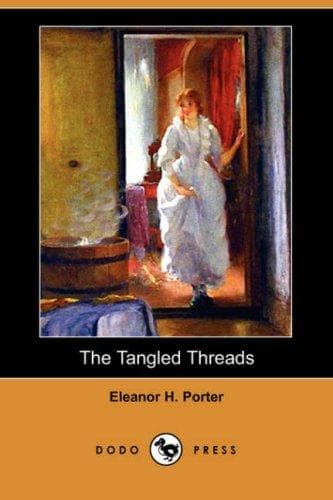
The Tangled ThreadsPorter, Eleanor H. (Eleanor Hodgman)
General
The Tangled Threads
Porter, Eleanor H. (Eleanor Hodgman)
Children's stories, American; Short stories
It was not long after this that the picture disappeared from the
parlor. Hephzibah had borne it very carefully to her room and hung it
on the wall at the foot of her bed, where her eyes would open upon it
the first thing every morning. Each day she talked to it, and each day
it grew to be more and more a part of her very self. Not until the
picture had been there a week, however, did she suddenly realize that
it represented the twilight hour; then, like a flash of light, came her
inspiration.
"It's at sunset--I'll go out at sunset! Now my Angelus will come to
me," she cried softly. "I know it will!"
Then did the little hillside farmhouse see strange sights indeed. Each
night, as the sun dropped behind the far-away hills, Hephzibah left her
work and passed through the kitchen door, her face uplifted, and her
eyes on the distant sky-line.
Sometimes she would turn to the left to the open field and stand there
motionless, unconsciously falling into the reverent attitude now so
familiar to her; sometimes she would turn to the right and pause at the
brow of the hill, where the valley in all its panorama of loveliness
lay before her; and sometimes she would walk straight ahead to the old
tumble-down gate where she might face the west and watch the rose
change to palest amber in the sky.
At first her eyes saw but grass, sky, and dull-brown earth, and her
thoughts turned in bitterness to her unfinished tasks; but gradually
the witchery of the summer night entered her soul and left room for
little else. Strange faces, peeping in and out of the clouds, looked
at her from the sky; and fantastic figures, clothed in the evening
mist, swept up the valley to her feet. The grass assumed a deeper
green, and the trees stood out like sentinels along the hilltop behind
the house. Even when she turned and went back to the kitchen, and took
upon herself once more the accustomed tasks, her eyes still faintly
glowed with the memory of what they had seen.
"It do beat all," said Theron a month later to Helen Raymond, who was
again a visitor at the farm,--"it do beat all, Helen, what's come over
yer aunt. She used ter be nervous-like, and fretted, an' things never
went ter suit. Now she's calm, an' her eyes kind o' shine--'specially
when she comes in from one of them tramps of hers outdoors. She says
it's her Angelus--if ye know what that is; but it strikes me as mighty
queer--it do, Helen, it do!"
And Helen smiled, content.
The Apple of Her Eye
It rained. It had rained all day. To Helen Raymond, spatting along the
wet slipperiness of the drenched pavements, it seemed as if it had always
rained, and always would rain.
Helen was tired, blue, and ashamed--ashamed because she was blue; blue
because she was tired; and tired because--wearily her mind reviewed her
day.
Public-domain text, read in full here on John Shaqi.
Reviews
Reviews
No reviews yet
Be the first to share your thoughts on this work.
Join the Discussion
Join the discussion
Sign in to leave a comment or review.
Sign InorCreate an account