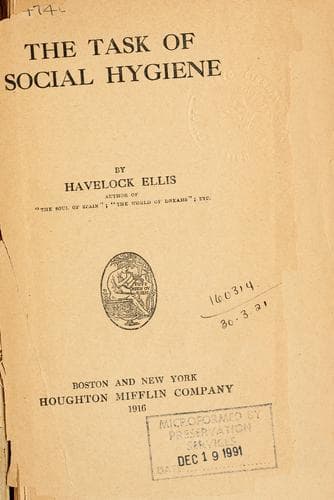
Eugenics; Sexual ethics; Women -- Social and moral questions
At an early stage, however, it began to be seen that this process of
sanitation, necessary as it had become, was far too crude and elementary
to achieve the ends sought. It was not enough to improve the streets, or
even to regulate the building of dwellings. It was clearly necessary to
regulate also the conditions of work of the people who lived in those
streets and dwellings. Thus it was that the scheme of factory
legislation was initiated. Rules were made as to the hours of labour,
more especially as regards women and children, for whom, moreover,
certain specially dangerous or unhealthy occupations were forbidden, and
an increasingly large number of avocations were brought under Government
inspection. This second stage of social reform encountered a much more
strenuous opposition than the first stage. The regulation of the order
and cleanliness of the streets was obviously necessary, and it had
indeed been more or less enforced even in medieval times;[2] but the
regulation of the conditions of work in the interests of the worker was
a more novel proceeding, and it appeared to clash both with the
interests of the employers and the ancient principles of English freedom
and independence, behind which the employers consequently sheltered
themselves. The early attempts to legislate on these lines were thus
fruitless. It was not until a distinguished aristocratic philanthropist
of great influence, the seventh Earl of Shaftesbury, took up the
question, that factory legislation began to be accepted. It continues to
develop even to-day, ever enlarging the sphere of its action, and now
meeting with no opposition. But, in England, at all events, its
acceptance marks a memorable stage in the growth of the national spirit.
It was no longer easy and natural for the Englishmen to look on at
suffering without interference. It began to be recognized that it was
perfectly legitimate, and even necessary, to put a curb on the freedom
and independence which involved suffering to others.
But as the era of factory legislation became established, a further
advance was seen to be necessary. Factory legislation had forbidden the
child to work. But the duty of the community towards the child, the
citizen of the future, was evidently by no means covered by this purely
negative step. The child must be prepared to take his future part in
life, in the first place by education. The nationalization of education
in England dates from 1870. But during the subsequent half century
"education" has come to mean much more than mere instruction; it now
covers a certain amount of provision for meals when necessary, the
enforcement of cleanliness, the care of defective conditions, inborn or
acquired, with special treatment for mentally defective children, an
ever-increasing amount of medical inspection and supervision, while it
is beginning to include arrangements for placing the child in work
suited to his capacities when he leaves school.
Public-domain text, read in full here on John Shaqi.
Reviews
Reviews
No reviews yet
Be the first to share your thoughts on this work.
Join the Discussion
Join the discussion
Sign in to leave a comment or review.
Sign InorCreate an account