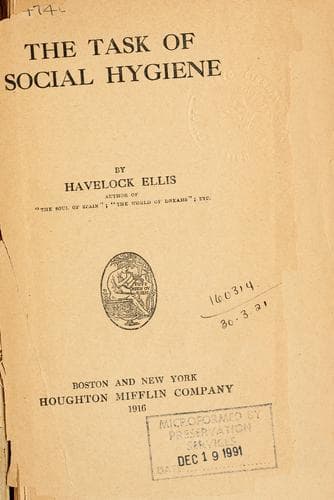
Eugenics; Sexual ethics; Women -- Social and moral questions
Looked at dispassionately, the two main disadvantages of the suffragette
agitation--and they certainly seem at the first glance very
comprehensive objections--lie in its direction and in its methods. There
are two vast bodies of people who require to be persuaded in order to
secure woman's suffrage: first women themselves, and secondly their
men-folk, who at present monopolize the franchise. Until the majority of
both men and women are educated to understand the justice and
reasonableness of this step, and until men are persuaded that the time
has come for practical action, the most violent personal assaults on
cabinet ministers--supposing such political methods to be otherwise
unobjectionable--are beside the mark. They are aimed in the wrong
direction. This is so even when we leave aside the fact that
politicians are sufficiently converted already. The primary task of
women suffragists is to convert their own sex. Indeed it may be said
that that is their whole task. Whenever the majority of women are
persuaded that they ought to possess the vote, we may be quite sure that
they will communicate that persuasion to their men-folk who are able to
give them the vote. The conversion of the majority of women to a belief
in women's suffrage is essential to its attainment because it is only by
the influence of the women who belong to him, whom he knows and loves
and respects, that the average man is likely to realize that, as Ellen
Key puts it, "a ballot paper in itself no more injures the delicacy of a
woman's hand than a cooking recipe." The antics of women in the street,
however earnest those women may be, only leave him indifferent, even
hostile, at most, amused.
It may be added that in any case it would be undesirable, even if
possible, to bestow the suffrage on women so long as only a minority
have the wish to exercise it. It would be contrary to sound public
policy. It would not only discredit political rights, but it would tend
to give the woman's vote too narrow and one-sided a character. To grant
women the right to vote is a different matter from granting women the
right to enter a profession. In order to give women the right to be
doctors or lawyers it is not necessary that women generally should be
convinced of the advantage of such a step. The matter chiefly concerns
the very small number of women who desire the privilege. But the women
who vote will be in some measure legislating for women generally, and it
is therefore necessary that women generally should participate.
Public-domain text, read in full here on John Shaqi.
Reviews
Reviews
No reviews yet
Be the first to share your thoughts on this work.
Elsewhere in the archive
Join the Discussion
Join the discussion
Sign in to leave a comment or review.
Sign InorCreate an account