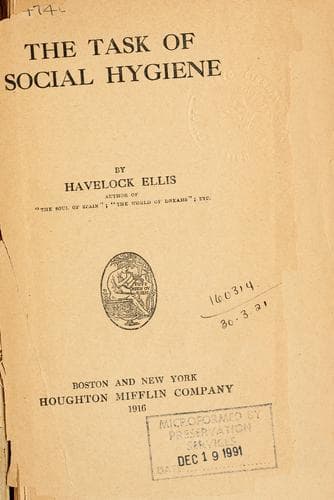
Eugenics; Sexual ethics; Women -- Social and moral questions
It is easy to exaggerate the misdeeds and the weaknesses of the
suffragettes. It is undoubtedly true that they have alienated, in an
increasing degree, the sympathies of the women of highest character and
best abilities among the advocates of woman's suffrage. Nearly all
Englishwomen to-day who stand well above the average in mental
distinction are in favour of woman's suffrage, though they may not
always be inclined to take an active part in securing it. Perhaps the
only prominent exception is Mrs. Humphry Ward. Yet they rarely associate
themselves with the methods of the suffragettes. They do not, indeed,
protest, for they feel there would be a kind of disloyalty in fighting
against the Extreme Left of a movement to which they themselves belong;
but they stand aloof. The women who are chiefly attracted to the ranks
of the suffragettes belong to three classes: (1) Those of the well-to-do
class with no outlet for their activities, who eagerly embrace an
exciting occupation which has become, not only highly respectable, but
even, in a sense, fashionable; they have no natural tendency to excess,
but are easily moved by their social environment; some of these are
rich, and the great principle--once formulated in an unhappy moment
concerning a rich lady interested in social reform--"We must not kill
the goose that lays the golden eggs," has never been despised by the
suffragette leaders; (2) the rowdy element among women which is not so
much moved to adopt the methods for the sake of the cause as to adopt
the cause for the sake of the methods, so that in the case of their
special emotional temperament it may be said, reversing an ancient
phrase, that the means justify the end; this element of noisy
explosiveness, always found in a certain proportion of women, though
latent under ordinary circumstances, is easily aroused by stimulation,
and in every popular revolt the wildest excesses are the acts of women.
(3) In this small but important group we find women of rare and
beautiful character who, hypnotized by the enthralling influence of an
idea, and often having no great intellectual power of their own, are
even unconscious of the vulgarity that accompanies them, and gladly
sacrifice themselves to a cause that seems to be sacred; these are the
saints and martyrs of every movement.
When we thus analyse the suffragette outburst we see that it is really
compounded out of quite varied elements: a conventionally respectable
element, a rowdy element, and an ennobling element. It is, therefore,
equally unreasonable to denounce its vices or to idealize its virtues.
It is more profitable to attempt to balance its services and its
disservices to the cause of women's suffrage.
Public-domain text, read in full here on John Shaqi.
Reviews
Reviews
No reviews yet
Be the first to share your thoughts on this work.
Elsewhere in the archive
Join the Discussion
Join the discussion
Sign in to leave a comment or review.
Sign InorCreate an account