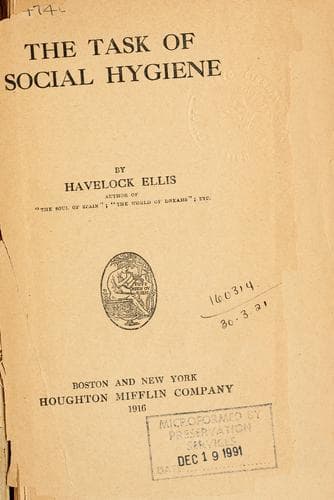
Eugenics; Sexual ethics; Women -- Social and moral questions
Ellen Key's views are mainly contained in three books, _Love and
Marriage_, _The Century of the Child_, and _The Women's Movement_, in
which form they enjoy a large circulation, and are now becoming well
known, through translations, in England and America. She carefully
distinguishes her aims from what she regards as the American conception
of progress in woman's movements, that is to say the tendency for women
to seek to capture the activities which may be much more adequately
fulfilled by the other sex, while at the same time neglecting the far
weightier matters that concern their own sex. Man and woman are not
natural enemies who need to waste their energies in fighting over their
respective rights and privileges; in spiritual as in physical life they
are only fruitful together. Women, indeed, need free scope for their
activities--and the earlier aspirations of feminism are thus
justified--but they need it, not to wrest away any tasks that men may be
better fitted to perform, but to play their part in that field of
creative life which is peculiarly their own. Ellen Key would say that
the highest human unit is triune: father, mother, and child. Marriage,
therefore, instead of being, as it is to-day, the last thing to be
thought of in education, becomes the central point of life. In Ellen
Key's conception, "those who love each other are man and wife," and by
love she means not a temporary inclination, but "a synthesis of desire
and friendship," just as the air is a mixture of oxygen and nitrogen. It
must be this for both sexes alike, and Ellen Key sees a real progress in
what seems to her the modern tendency for men to realize that the soul
has its erotic side, and for women to realize that the senses have. She
has no special sympathy with the cry for purity in masculine candidates
for marriage put forward by some women of the present day. She observes
that many men who have painfully struggled to maintain this ideal meet
with disillusion, for it is not the masculine lamb, but much more the
spotted leopard, who fascinates women. The notion that women have higher
moral instincts than men Ellen Key regards as absurd. The majority of
Frenchwomen, she remarks, were against Dreyfus, and the majority of
Englishwomen approved the South African war. The really fundamental
difference between man and woman is that he can usually give his best as
a creator, and she as a lover, that his value is according to his work
and hers according to her love. And in love the demand for each sex
alike must not be primarily for a mere anatomical purity, but for
passion and for sincerity.
Public-domain text, read in full here on John Shaqi.
Reviews
Reviews
No reviews yet
Be the first to share your thoughts on this work.
Elsewhere in the archive
Join the Discussion
Join the discussion
Sign in to leave a comment or review.
Sign InorCreate an account