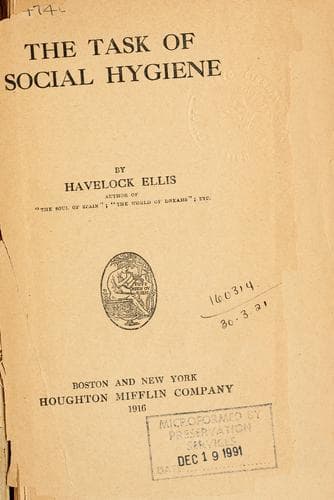
Eugenics; Sexual ethics; Women -- Social and moral questions
It has probably excited surprise in the minds of some who have been
impressed by the magnitude and vitality of this movement that it should
have manifested itself in Germany rather than in England, which is the
original home of movements for women's emancipation, or in America,
where they have reached their fullest developments. This, however,
ceases to be surprising when we realize the special qualities of the
Anglo-Saxon and Teutonic temperaments and the special conditions under
which the two movements arose. The Anglo-Saxon movement was a special
application to women of the general French movement for the logical
assertion of abstract human rights. That special application was not
ardently taken up in France itself, though first proclaimed by French
pioneers,[68] partly perhaps because such one-sided applications make
little appeal to the French mind, and mainly, no doubt, because women
throughout the eighteenth century enjoyed such high social
consideration and exerted so much influence that they were not impelled
to rise in any rebellious protest. But when the seed was brought over to
England, especially in the representative form of Mary Wollstonecraft's
_Vindication of the Rights of Women_, it fell in virgin soil which
proved highly favourable to its development. This special application
escaped the general condemnation which the Revolution had brought upon
French ideas. Women in England were beginning to awaken to ideas,--as
women in Germany are now,--and the more energetic and intelligent among
them eagerly seized upon conceptions which furnished food for their
activities. In large measure they have achieved their aims, and even
woman's suffrage has been secured here and there, without producing any
notable revolution in human affairs. The Anglo-Saxon conception of
feminine progress--beneficial as it has undoubtedly been in many
respects--makes little impression in Germany, partly because it fails to
appeal to the emotional Teutonic temperament, and partly because the
established type of German life and civilization offers very small scope
for its development. When Miss Susan Anthony, the veteran pioneer of
woman's movements in the United States, was presented to the German
Empress she expressed a hope that the Emperor would soon confer the
suffrage on German women; it is recorded that the Empress smiled, and
probably most German women smiled with her. At the present time,
however, there is an extraordinary amount of intellectual activity in
Germany, a widespread and massive activity. For the first time,
moreover, it has reached women, who are taking it up with characteristic
Teutonic thoroughness. But they are not imitating the methods of their
Anglo-Saxon sisters; they are going to work their own way. They are
spending very little energy in waving the red flag before the fortresses
of male monopoly. They are following an emotional influence which,
strangely enough, it may seem to some, finds more support from the
Public-domain text, read in full here on John Shaqi.
Reviews
Reviews
No reviews yet
Be the first to share your thoughts on this work.
Elsewhere in the archive
Join the Discussion
Join the discussion
Sign in to leave a comment or review.
Sign InorCreate an account