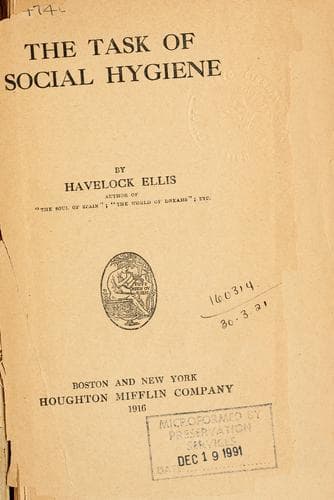
Eugenics; Sexual ethics; Women -- Social and moral questions
biological and medical side than the Anglo-Saxon movement has always
been able to win. From the time of Aristophanes downwards, whenever they
have demonstrated before the masculine citadels, women have always been
roughly bidden to go home. And now, here in Germany, where of all
countries that advice has been most freely and persistently given, women
are adopting new tactics: they have gone home. "Yes, it is true," they
say in effect, "the home is our sphere. Love and marriage, the bearing
and the training of children--that is our world. And we intend to lay
down the laws of our world."
FOOTNOTES:
[52] In 1787 Condorcet declared (_Lettres d'un Bourgeois de New Haven_,
Lettre II) that women ought to have absolutely the same rights as men,
and he repeated the same statement emphatically in 1790, in an article
"Sur l'Admission des Femmes au Droit de Cite," published in the _Journal
de la Societe de 1789_. It must be added that Condorcet was not a
democrat, and neither to men nor to women would he grant the vote unless
they were proprietors.
[53] Leopold Lacour has given a full and reliable account of Olympe de
Gouges (who was born at Montauban in 1755) in his _Trois Femmes de la
Revolution_, 1900.
[54] It is noteworthy that the Empire had even a depressing effect on the
physical activities of women. The eighteenth-century woman in France,
although she was not athletic in the modern sense, enjoyed a free life
in the open air and was fond of physical exercises. During the
Directoire this tendency became very pronounced; women wore the
scantiest of garments, were out of doors in all weathers, cultivated
healthy appetites, and enjoyed the best of health. But with the
establishment of the Empire these wholesome fashions were discarded, and
women cultivated new ideals of fragile refinement indoors. (This
evolution has been traced by Dr. Lucien Nars, _L'Hygiene_, September,
1911.)
[55] Concerning the rise and progress of this movement in England much
information is sympathetically and vivaciously set forth in W. Lyon
Blease's _Emancipation of English Women_ (1910), a book, however, which
makes no claim to be judicial or impartial; the author regards
"unregulated male egoism" as the source of the difficulties in the way
of women's suffrage.
[56] Thus, in 1911 the National League for Opposing Women's Suffrage took
an impartial poll of the women voters on the municipal register in
several large constituencies, by sending a reply-paid postcard to ask
whether or not they favoured the extension to women of the Parliamentary
franchise. Only 5579 were in favour of it; 18,850 were against; 12,621
did not take the trouble to answer, and it was claimed, probably with
reason, that a majority of these were not in favour of the vote.
Public-domain text, read in full here on John Shaqi.
Reviews
Reviews
No reviews yet
Be the first to share your thoughts on this work.
Elsewhere in the archive
Join the Discussion
Join the discussion
Sign in to leave a comment or review.
Sign InorCreate an account