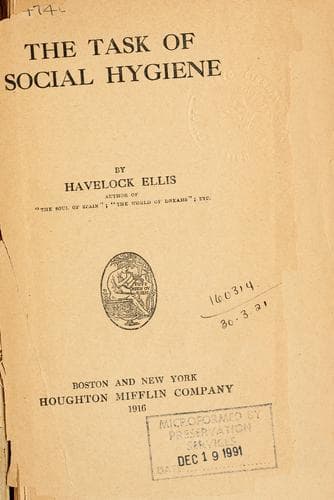
Eugenics; Sexual ethics; Women -- Social and moral questions
It would be premature to attempt to define the exact outline of the new
forms of romantic love, or the precise lineaments of the beings who will
most ardently evoke that love. In literature, indeed, the ideals of life
cast their shadow before, and we may surely trace a change in the erotic
ideals mirrored in literature. The woman whom Dickens idealized in
_David Copperfield_ is unlike indeed to the series of women of a new
type introduced by George Meredith, and the modern heroine generally
exhibits more of the robust, open-eyed and spontaneous qualities of that
later type than the blind and clinging nature of the amiable simpletons
of the older type. That the changed conditions of civilization should
produce new types of womanhood and of love is not surprising, if we
realize that, even within the ancient chivalrous forms it was possible
to produce similar robust types when the qualities of a race were
favourable to them. Spain furnishes a notable illustration. Spanish
literature from Cervantes and Tirso to Valera and Blasco Ibanez reflects
a type of woman who stands on the same ground as man and is his equal
and often his superior on that ground, alike in vigour of body and of
spirit, acquiring all that she cares to of virility, while losing
nothing feminine that is of worth.[87] In more than one respect the
ideal woman of Spain is the ideal woman our civilization now renders
necessary. The women of the future, Grete Meisel-Hess declares in her
femininely clever and frank discussion of present-day conditions, _Die
Sexuelle Krise_, will be full, strong, elementary natures, devoid alike
of the impulse to destroy or the aptitude to be destroyed. She
considers, moreover, that so far from romantic love being a thing of the
past, "love as a form of worship is reserved for the future."[88] In the
past it has only been found among a few rare souls; in the future world,
fostered by the finer selection of a conscious eugenics, and a new
reverence and care for motherhood, we may reasonably hope for a truly
efficient humanity, the bearers and conservers of the highest human
emotions. It is in this sense, indeed, that the voices of the greatest
and most typical leaders of the woman's movement of emancipation to-day
are heard. Ellen Key, in her _Love and Marriage_, seeks to conciliate
the cultivation of a free and sacred sexual relationship with the
worship of the child, as the embodiment of the future race, while Olive
Schreiner proclaims in her _Woman and Labour_ that the woman of the
future will walk side by side with man in a higher and deeper
relationship than has ever been possible before because it will involve
a new community in activity and insight.
Public-domain text, read in full here on John Shaqi.
Reviews
Reviews
No reviews yet
Be the first to share your thoughts on this work.
Elsewhere in the archive
Join the Discussion
Join the discussion
Sign in to leave a comment or review.
Sign InorCreate an account