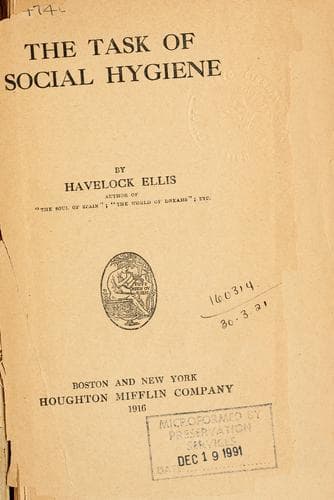
Eugenics; Sexual ethics; Women -- Social and moral questions
Nor is it alone from the feminine side that these forecasts are made.
Certainly for the most part love has been cultivated more by women than
by men. Primacy in the genius of intellect belongs incontestably to men,
but in the genius of love it has doubtless oftener been achieved by
women. They have usually understood better than men that in this matter,
as Goethe insisted, it is the lover and not the beloved who reaps the
chief fruits of love. "It is better to love, even violently," wrote the
forsaken Portuguese nun, in her immortal _Letters_, "than merely to be
loved." He who loses his life here saves it, for it is only in so far as
he becomes a crucified god that Love wins the sacrifice of human hearts.
Of late years, by an inevitable reaction, women have sometimes forgotten
this eternal verity. The women of the twentieth century in their anxiety
for self-possession and their rightful eagerness to gain positions they
feel they have been too long excluded from, have perhaps yet failed to
realize that the women of the eighteenth century, who exerted a sway
over life that the women of no age before or since have possessed, were,
above all women, great and heroic lovers, and that those two fundamental
facts cannot be cut asunder. But this failure, temporary as it is
doubtless destined to be, will work for good if it is the point of
departure for a revival among men of the art of love.
Men indeed have here fallen behind women. The old saying, so tediously
often quoted, concerning love as a "thing apart" in the lives of men
would scarcely have occurred to a medieval poet of Provence or Florence.
It is not enough for women to proclaim a new avatar of love if men are
not ready and eager to learn its art and to practise its discipline. In
a profoundly suggestive fragment on love, left incomplete at his death
by the distinguished sociologist Tarde,[89] he suggests that when
masculine energy dies down in the fields of political ambition and
commercial gain, as it already has in the field of warfare, the energy
liberated by greater social organization and cohesion may find scope
once more in love. For too long a period love, like war and politics and
commerce, has been chiefly monopolized by the predatory type of man, in
this field symbolized by the figure of Don Juan. In the future, Tarde
suggests, the Don Juan type of lover may fall into disrepute, giving
place to the Virgilian type, for whom love is not a thing apart but a
form of life embodying its best and highest activities.
Public-domain text, read in full here on John Shaqi.
Reviews
Reviews
No reviews yet
Be the first to share your thoughts on this work.
Elsewhere in the archive
Join the Discussion
Join the discussion
Sign in to leave a comment or review.
Sign InorCreate an account