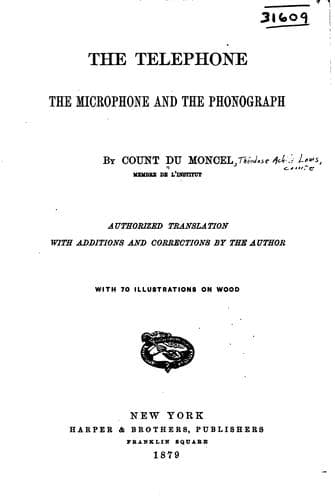
The telephone, the microphone & the phonographDu Moncel, Th., comte
History
The telephone, the microphone & the phonograph
Du Moncel, Th., comte
Microphone; Phonograph; Telephone
The experiments on the microphone made in London at the meeting of the
Society of Telegraphic Engineers on May 25, 1878, were wonderfully
successful, and they were the subject of an interesting article in
the ‘Engineer’ of May 31, which asserts that the whole assembly heard
the microphone speak, and that its voice was very like that of the
phonograph. When the meeting was informed that these words had been
uttered at some distance from the microphone, the Duke of Argyll,
who was present, while admiring the important discovery, could not
help exclaiming that this invention might have terrible consequences,
since, for instance, if one of Professor Hughes’s instruments were
placed in the room in Downing Street, in which Her Majesty’s ministers
hold their cabinet council, their secrets might be heard in the room
in which the present meeting took place. He added that if one of these
little instruments were in the pocket of Count Schouvaloff, or of Lord
Salisbury, we should at once be in possession of the secrets for which
all Europe was anxiously waiting. If these instruments were able to
repeat all the conversations held in the room in which they stood, they
might be really dangerous, and the Duke thought that Professor Hughes,
who had invented such a splendid yet perilous instrument, ought next to
seek an antidote for his discovery. Dr. Lyon Playfair, again, thought
that the microphone ought to be applied to the aërophone, so that by
placing these instruments in the two Houses of Parliament, the speeches
of great orators might be heard by the whole population within five or
six square miles.
The experiments lately made with the microphone at Halifax show that
the Duke of Argyll’s predictions were fully justified. It seems that
a microphone was placed on a pulpit-desk in a church in Halifax, and
connected by a wire about two miles long with a telephone placed close
to the bed of a sick person, who was able to hear the prayers, the
chanting, and the sermon. This fact was communicated to me by Mr.
Hughes, who heard it from a trustworthy source, and it is said that
seven patients have subscribed for the expense of an arrangement by
which they may hear the church services at Halifax without fatigue.
The microphone has also lately been applied to the transmission of a
whole opera, as we learn from the following account in the ‘Journal
Télégraphique,’ Berne, July 25, 1878:--
Public-domain text, read in full here on John Shaqi.
Reviews
Reviews
No reviews yet
Be the first to share your thoughts on this work.
Elsewhere in the archive
Join the Discussion
Join the discussion
Sign in to leave a comment or review.
Sign InorCreate an account