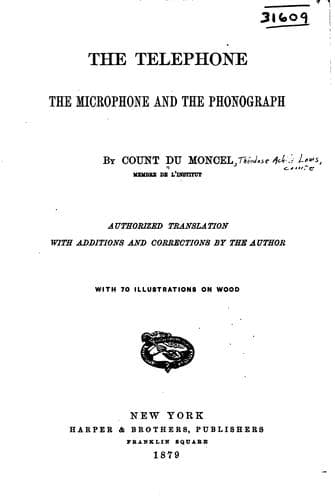
The telephone, the microphone & the phonographDu Moncel, Th., comte
History
The telephone, the microphone & the phonograph
Du Moncel, Th., comte
Microphone; Phonograph; Telephone
‘A curious micro-telephonic experiment took place on June 19 at
Bellinzona, Switzerland. A travelling company of Italian singers was to
perform Donizetti’s opera, “Don Pasquale,” at the theatre of that town.
M. Patocchi, a telegraphic engineer, took the opportunity of making
experiments on the combined effects of Hughes’s carbon microphone as
the sending instrument, and Bell’s telephone as the receiver. With
this object he placed a Hughes microphone in a box on the first tier,
close to the stage, and connected it by two wires, from one to half a
millimètre in thickness, to four Bell receivers, which were placed in a
billiard-room above the vestibule of the theatre, and inaccessible to
sounds within the theatre itself. A small battery of two cells, of the
ordinary type used in the Swiss telegraphic service, was inserted in
the circuit, close to the Hughes microphone.
‘The result was completely successful. The telephones exactly
reproduced, with wonderful purity and distinctness, the instrumental
music of the orchestra, as well as the voices of the singers. Several
people declared that they did not lose a note of either, that the
words were heard perfectly; the airs were reproduced in a natural key,
with every variation, whether _piano_ or _forte_, and several amateurs
assured M. Patocchi that by listening to the telephone they were able
to estimate the musical beauty, the quality of the singers’ voices,
and the general effect of the piece, as completely as if they had been
among the audience within the theatre.
‘The result was the same when resistances equivalent to 10 kilomètres
were introduced into the circuit, without increasing the number of
cells in the battery. We believe that this is the first experiment of
the kind which has been made in Europe, at least in a theatre, and
with a complete opera; and those who are acquainted with the delicacy
and grace of the airs in “Don Pasquale” will be able to appreciate the
sensitiveness of the combined instruments invented by Hughes and Bell,
which do not suffer the most delicate touches of this music to be lost.’
Public-domain text, read in full here on John Shaqi.
Reviews
Reviews
No reviews yet
Be the first to share your thoughts on this work.
Elsewhere in the archive
Join the Discussion
Join the discussion
Sign in to leave a comment or review.
Sign InorCreate an account