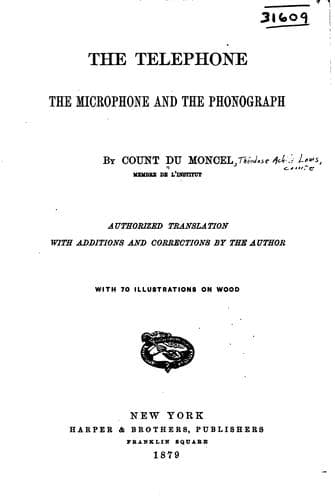
The telephone, the microphone & the phonographDu Moncel, Th., comte
History
The telephone, the microphone & the phonograph
Du Moncel, Th., comte
Microphone; Phonograph; Telephone
1. If a magnetising coil, surrounding a bar of soft iron, is inserted
in the circuit of a microphone, with a battery of three cells, the
ticking of a watch and other sounds of the same kind may be heard
on approaching the ear to the electro-magnet which has been thus
constituted. It is true that these sounds are very faint when they are
not amplified, but if the electro-magnet is fastened to a board, and
a second microphone is fixed to the same board, the sounds produced by
the electro-magnet are magnified, and become distinctly audible in the
telephone which is placed in connection with this second microphone.
2. These sounds may be further amplified by resting one of the
extremities of the core of the electro-magnet on one of the poles of
a permanent magnet, which is fixed upon the board. Articulate speech
may then be heard in the telephone which is placed in connection with
the microphone resting on the board, and the point at issue between
MM. Navez and Du Moncel is completely decided in this way: for the
auxiliary microphone can only propagate and amplify the vibration of
articulate sounds, which are communicated by the bar magnet of the coil
to the board on which the two instruments are placed. In this way it
would be possible to render articulate sounds perceptible to M. Navez,
when transmitted by the bar magnet of a telephone without a diaphragm.
3. When a second bar magnet rests on the free pole of the
electro-magnet, so as to present to it a pole of the same nature as the
one with which it is already in communication--in a word, if a bar is
placed between the two poles of a horseshoe electro-magnet, the effects
are still more marked, and hence it may be assumed that the bar reacts
as an armature, by concentrating the lines of magnetic force in the
vicinity of the helix.
4. When the two poles of a horseshoe magnet are inserted together
inside a coil, their effects are equally energetic, although by this
arrangement one of the poles might be expected to neutralise the
effect of the other: but the most important effects have been obtained
by placing an armature of soft iron across the poles of the magnet
which has been already inserted in the coil. Under these conditions
articulate sounds are distinctly heard.
These experiments were confirmed by Mr. F. Varley, in a letter
published in the ‘Telegraphic Journal’ of September 15, 1878, and among
the fresh experiments mentioned by him, we will quote those which he
made with an iron tube inserted in a helix, in which the two opposite
poles of two bar magnets are introduced. These poles are only separated
from each other by the interval of an inch, so that the centre of the
iron tube may be strongly magnetised.
Public-domain text, read in full here on John Shaqi.
Reviews
Reviews
No reviews yet
Be the first to share your thoughts on this work.
Elsewhere in the archive
Join the Discussion
Join the discussion
Sign in to leave a comment or review.
Sign InorCreate an account