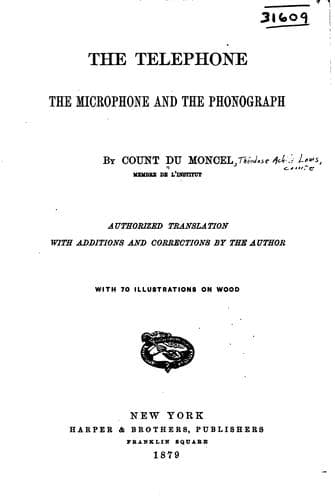
The telephone, the microphone & the phonographDu Moncel, Th., comte
History
The telephone, the microphone & the phonograph
Du Moncel, Th., comte
Microphone; Phonograph; Telephone
Although experiments with the microphone are of such recent date, they
have been very various, and among other curious experiments we learn
from the English newspapers that the attempt has been made to construct
an instrument on the same principle as the telephone, which shall be
sensitive to the variations of light. It is known that some substances,
and particularly selenium, are electrically affected by light, that is,
that their conductivity varies considerably with the greater or less
amount of light which is shed upon them. If, therefore, a circuit in
which a substance of this nature is inserted, is abruptly subjected to
a somewhat intense light, the increase of resistance which results from
it ought to produce a powerful sound in a telephone inserted in the
circuit. This fact has been verified by experiment, and Mr. Willoughby
Smith infers from it, as we have already suggested, that the effects
produced in the microphone are due to variations of resistance in the
circuit, which are produced by more or less close contacts between
imperfect conductors.
In order to obtain this effect under the most favourable conditions,
Mr. Siemens employs two electrodes, consisting of network of very
fine platinum wire, fitting into each other like two forks, of which
the prongs are interlaced. These electrodes are inserted between two
glass plates, and a drop of selenium, dropped in the centre of the two
pieces of network, connects them on a circular surface large enough
to establish sufficient conductivity in the circuit. It is on this
flattened drop that the ray of light must be projected.
APPLICATIONS OF THE MICROPHONE.
The applications of the microphone increase in number every day, and
in addition to those of which we have just spoken, there are others of
really scientific and even of practical interest. Among the number is
the use which can be made of it as a system of relays for telegraphy,
in science for the study of vibrations imperceptible to our senses, in
medicine and surgery, and even in manufactures.
_Its application to Scientific Research._--We have seen that several
physicists, including Messrs. Spottiswoode, Warwick, Rossetti,
Canestrelli, Wiesendanger, Lloyd, Millar, Buchin, and Blyth, have been
able to hear what is said in a telephone which has no iron diaphragm,
but it was so difficult to establish the fact that it has been often
disputed. More certain evidence was desirable, and the microphone is an
opportune agent for affording it.
The ‘Telegraphic Journal’ of September 1, 1878, observes that M.
du Moncel, in order to claim the victory in his controversy with
Colonel Navez, had still to show that the sounds which appeared
to be inarticulate in telephones without a diaphragm might become
intelligible if they were intensified. This has been done for him by
the use of Mr. Hughes’s microphone, and the following experiments were
made for the purpose.
Public-domain text, read in full here on John Shaqi.
Reviews
Reviews
No reviews yet
Be the first to share your thoughts on this work.
Elsewhere in the archive
Join the Discussion
Join the discussion
Sign in to leave a comment or review.
Sign InorCreate an account