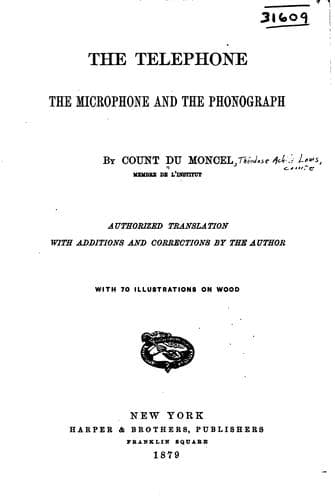
The telephone, the microphone & the phonographDu Moncel, Th., comte
History
The telephone, the microphone & the phonograph
Du Moncel, Th., comte
Microphone; Phonograph; Telephone
The obstacles which occur in telephonic transmissions proceed from
three causes: 1. The intensity of sound is diminished by the loss of
current in transmission--a loss which is much greater in the case of
induced currents than in those received from a battery. 2. Confusion
is caused by the influence of adjacent currents. 3. The induction
from one wire to another. This last influence is much greater than is
usually supposed. If two perfectly insulated wires are placed side
by side, one in communication with the circuit of an electric bell,
and the other with the circuit of a telephone, the latter will repeat
the sounds of the bell with an intensity often great enough to act as
a call without applying the instrument to the ear. MM. Pollard and
Garnier, in their interesting experiments with the induced currents
of the Ruhmkorff coil, have ascertained that in this way not merely
sounds may be obtained which correspond with the induced currents
resulting from the action of the primary current, but also those which
result from the action of the secondary current on other helices, which
are termed currents of the second order. These different reactions
frequently cause the telephonic transmissions made on telegraphic
lines to be disturbed by irregular sounds, arising from the electric
transmissions on adjoining lines; but it does not appear that these
influences altogether neutralise each other, so that conversation held
in the ordinary way and a message sent in the Morse code may be heard
simultaneously.
At the Artillery School, Clermont, a telephonic communication has
been established, for the sake of experiments, between the school
and the butts, which are at a distance of about eight miles. Another
communication of the same kind has been established between the
Clermont Observatory and the one at Puy-de-Dôme, which is nearly nine
miles from the former. These two lines are carried on the same posts
for a course of six miles, together with an ordinary telegraphic wire,
and for a distance of 330 yards there are seven other such wires.
The two telephonic wires are separated from each other by a space of
85 centimètres. The following facts have been observed under these
conditions.
1. The school telephone is perfectly able to read off from their sound
the Morse messages which pass through the two adjacent telegraph wires,
and the ticking of the instrument does not at all interfere with the
vocal communication of the telephone, nor render it inaudible.
2. The two adjacent telegraphic lines, although not in contact, confuse
their messages together, and it has sometimes been possible to hear
messages from Puy-de-Dôme at the school through the wire which runs to
the butts, although the distance between the two lines is nowhere less
than 85 centimètres.
These inconveniences have been in some degree remedied by inserting
strong resistances in the circuit, or by putting the current to earth
at some distance from the telephonic stations.
Public-domain text, read in full here on John Shaqi.
Reviews
Reviews
No reviews yet
Be the first to share your thoughts on this work.
Elsewhere in the archive
Join the Discussion
Join the discussion
Sign in to leave a comment or review.
Sign InorCreate an account