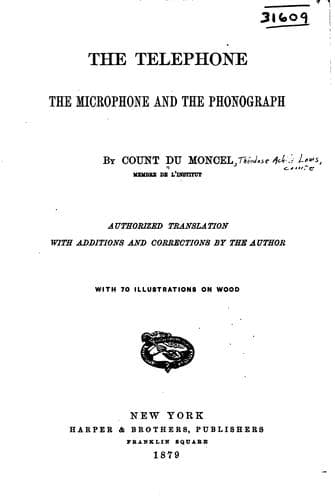
The telephone, the microphone & the phonographDu Moncel, Th., comte
History
The telephone, the microphone & the phonograph
Du Moncel, Th., comte
Microphone; Phonograph; Telephone
M. Izarn, Professor of Physics at the Lycée, Clermont, holds that
telephonic electric currents may readily be turned aside by the earth,
especially if in the course of their passage they encounter metallic
conductors, such as gas or water pipes. He writes as follows on the
subject, in a paper addressed to the Académie des Sciences, on May
13, 1878:--‘I set up a telephone in the Clermont Lycée with a single
wire, more than 50 yards in length, which crosses the court-yard of
the Lycée, and goes from the laboratory, where it is suspended to a
gas-burner, to a room near the porter’s lodge, where it is suspended
to another gas-burner. When I applied my ear to the telephone, I could
distinctly hear the telegraphic signals, Morse or otherwise, which came
either from the telegraph office at Clermont, or from the telephone
office which was at work between the School of Artillery and the butts
below Puy-de-Dôme, a distance of eight miles. I could overhear words,
and especially the military orders issued at the butts for the purpose
of being heard at the school. Yet my wire is perfectly independent of
those used for signalling, and is even very remote from them; but as
the wires of the telegraph office and of the School of Artillery go to
earth at a little distance from the gas-pipes, it is probable that this
phenomenon is caused by a diversion of the current produced in my wire,
by means of the earth and the network of metal pipes.’
Mr. Preece made the same remark in his notice of ‘some physical points
connected with the telephone.’ Again, we read in the ‘Telegraphic
Journal’ of June 15, 1878, that in a telephonic concert transmitted
from Buffalo to New York, the singers at Buffalo were heard in an
office placed outside the telegraphic circuit in which the transmission
was effected. On enquiry, it was ascertained that the wire through
which the telephonic transmission took place, was at one point in its
course close to the one which directly transmitted the musical sounds,
but the distance between the two wires was not less than ten feet.
Public-domain text, read in full here on John Shaqi.
Reviews
Reviews
No reviews yet
Be the first to share your thoughts on this work.
Elsewhere in the archive
Join the Discussion
Join the discussion
Sign in to leave a comment or review.
Sign InorCreate an account