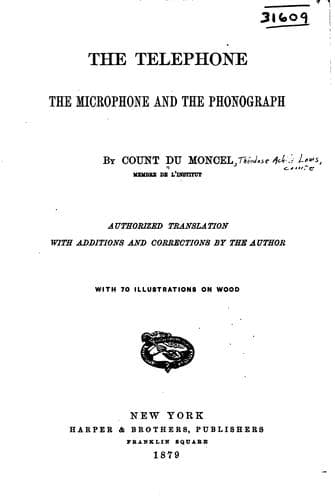
The telephone, the microphone & the phonographDu Moncel, Th., comte
History
The telephone, the microphone & the phonograph
Du Moncel, Th., comte
Microphone; Phonograph; Telephone
From the electro-static reactions, so strongly produced on the
submarine cables, in consequence of electric transmissions, it might be
supposed that it would not be easy to hold telephonic correspondence
through this kind of conductor, and, to ascertain the fact, an
experiment was made on the cable between Guernsey and Dartmouth, a
distance of sixty miles. Articulate speech, only a little indistinct,
was, however, perfectly transmitted. Other experiments, made by
Messrs. Preece and Wilmot, on an artificial submarine cable, placed
in conditions analogous to those of the Atlantic cable, showed that a
telephonic correspondence might be kept up at a distance of a hundred
miles, although the effects of induction were apparent. At the distance
of 150 miles, it was somewhat difficult to hear, and the sounds were
very faint, as if some one were speaking through a thick partition. The
sound diminished rapidly until the distance of 200 miles was reached,
and after that it became perfectly indistinct, although singing could
still be heard. It was even possible to hear through the whole length
of the cable, that is, for 3,000 miles, but Mr. Preece believed this to
be due to the induction of the condenser on itself: he holds, however,
that singing may be heard at a much greater distance than speech,
owing to the more regular succession of electric waves.
Mr. Preece also made experiments on the subterranean telegraphs
between Manchester and Liverpool, a distance of 30 miles, and found
no difficulty in exchanging correspondence; and it was the same with
the cable from Dublin to Holyhead, a distance of 67 miles. This cable
had seven conducting wires, and when the telephone was connected with
one of them, the sound was repeated through all the others, but in a
fainter degree. When the currents of the telegraphic instruments passed
through the wires, the induction was apparent, but not so great as to
prevent telephonic communication.
ESTABLISHMENT OF A TELEPHONIC STATION.
Although the telephonic system of telegraphy is very simple, yet
certain accessory arrangements are indispensable for its use. Thus,
for example, an alarum call is necessary, in order to know when the
exchange of correspondence is to take place, and information that
the call has been heard is likewise necessary. An electric bell is
therefore an indispensable addition to the telephone, and since the
same circuit may be employed for both systems, if a commutator is
used, it was necessary to find a mode of making the commutator act
automatically, so as to maintain the simple action of the system which
constitutes its principal merit.
_MM. Pollard and Garnier’s System._--With this object, MM. Pollard and
Garnier devised a very successful arrangement last March, which employs
the weight of the instrument to act upon the commutator.
Public-domain text, read in full here on John Shaqi.
Reviews
Reviews
No reviews yet
Be the first to share your thoughts on this work.
Elsewhere in the archive
Join the Discussion
Join the discussion
Sign in to leave a comment or review.
Sign InorCreate an account