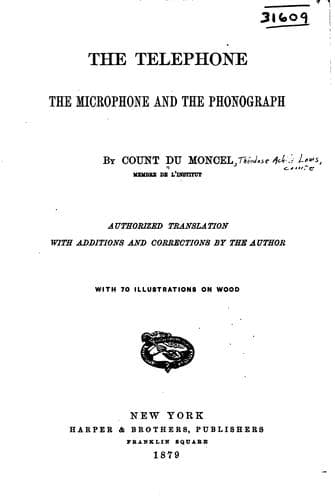
The telephone, the microphone & the phonographDu Moncel, Th., comte
History
The telephone, the microphone & the phonograph
Du Moncel, Th., comte
Microphone; Phonograph; Telephone
I studied these currents for a long time with the galvanometer, and
made them the subject of four papers which were laid before the
Académie des Sciences in 1872, and I am convinced that they have in
general nothing to do with atmospheric electricity, but result either
from thermo-electric or hydro-electric influence. They take place
constantly and in all weathers on telegraph lines, whether these lines
are insulated at one end, or in contact with the earth at both ends.
In the first case, the polar electrodes of the couple are formed by
the telegraph wire and the earth plate, generally of the same nature,
and the intermediate conducting medium is represented by the posts
which support the wire and the earth which completes the circuit. In
the second case, the couple is formed in almost the same way, but
the difference in the chemical composition of the ground at the two
points where the earth plates are buried, and sometimes their different
temperature, exert a strong influence. If only the first case be
considered, it generally happens that on fine summer days the currents
produced during the day are inverse to those which are produced by
night, and vary with the surrounding temperature in one or the other
direction. The presence or absence of the sun, the passage of clouds,
the currents of air involve abrupt and strongly marked variations,
which may be easily followed on the galvanometer, and which cause more
or less distinct sounds in the telephone.
During the day, the currents are directed from the telegraph line to
the earth plate, because the heat of the wire is greater than that of
the plate, and these currents are then thermo-electric. During the
night, on the other hand, the wire is cooled by the dew, which causes a
greater oxidation on the wire than that which takes place on the plate,
and the currents then become hydro-electric.
I say more about these currents because, in consequence of a mistaken
belief as to their origin, it has been supposed that the telephone
might serve for the study of the variations of the atmospheric
electricity generally diffused through the air. Such an application of
the telephone would, under these conditions, be not only useless, but
also misleading, by inducing the study of very complex phenomena, which
could lead to nothing more than I have already stated in my different
papers on the subject.
Certain local influences will also produce sounds in the telephone.
Thus the distension of the diaphragm by the moist heat of the breath,
when the instrument is held before the mouth in speaking, causes a
perceptible murmur.
Public-domain text, read in full here on John Shaqi.
Reviews
Reviews
No reviews yet
Be the first to share your thoughts on this work.
Elsewhere in the archive
Join the Discussion
Join the discussion
Sign in to leave a comment or review.
Sign InorCreate an account