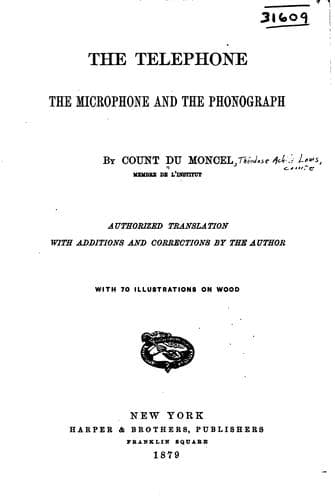
The telephone, the microphone & the phonographDu Moncel, Th., comte
History
The telephone, the microphone & the phonograph
Du Moncel, Th., comte
Microphone; Phonograph; Telephone
_System of M. Puluj._--There is yet another call system, devised
by M. Puluj. It consists of two telephones without mouthpieces,
connected together, and with coils placed opposite the branches of two
tuning-forks, tuned as nearly as possible to the same tone. A small
metal bell is fixed between the opposite faces of the tuning-forks, and
a wire stretched near them is provided with a small ball in contact
with their branches. When the tuning-fork at the sending station is put
in vibration by striking it with an iron hammer covered with skin, the
tuning fork at the other station vibrates also, and its ball strikes
upon the bell. As soon as the signal is returned by the second station,
mouthpieces with iron diaphragms are fastened to the telephones, and
the correspondence begins. It seems that, by the use of a resonator,
the sound which reaches the receiving station may be so intensified as
to become audible in a large hall, and the bell signal may be heard in
an adjoining room, even through a closed door.
_Mr. Alfred Chiddey’s System._--This arrangement consists of a slender
copper tube, eight inches long, and with an orifice of 1/30 of an inch,
of which the lower end is soldered to the diaphragm of a telephone. A
branch joint, to which an india-rubber tube is fitted, connects it with
a gas jet, which is lighted and surrounded with a lamp shade, in such
a way as to make it produce, under given conditions, sounds resembling
those of the singing flames. A perfectly similar system is arranged
at the other end of the line, in such a way that the sounds emitted
in each case shall be precisely in unison. If the two systems are so
regulated as not to emit sounds in their normal condition, they can
be made to sing by causing a tuning-fork in the vicinity of one or the
other to vibrate the same note, and then the corresponding flame will
begin to sing, producing a vibration in the diaphragm of the telephone
with which it is in correspondence, and hence will follow the vibration
of the diaphragm of the other telephone, and consequently the vibration
of the flame of the calling instrument. In this way the call signal may
be made without the intervention of any battery.
APPLICATIONS OF THE TELEPHONE.
Public-domain text, read in full here on John Shaqi.
Reviews
Reviews
No reviews yet
Be the first to share your thoughts on this work.
Elsewhere in the archive
Join the Discussion
Join the discussion
Sign in to leave a comment or review.
Sign InorCreate an account