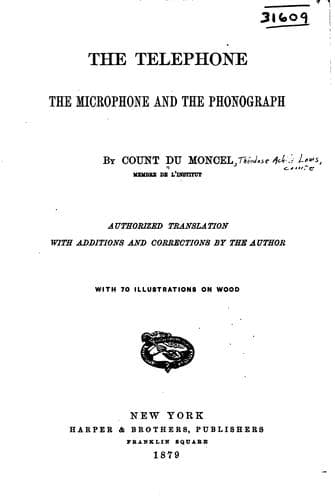
The telephone, the microphone & the phonographDu Moncel, Th., comte
History
The telephone, the microphone & the phonograph
Du Moncel, Th., comte
Microphone; Phonograph; Telephone
The applications of the telephone are much more numerous than might
be supposed at the first glance. As far as the telegraphic service
is concerned, its use must evidently be rather limited, since it
cannot register the messages sent, and the speed of transmission is
inferior to that of the improved system of telegraphs; yet in many
cases it would be very valuable, even for a telegraphic system, since
it is possible to work it without any special telegraphic training.
The first comer may send and receive with the telephone, and this is
certainly not the case even with the simplest forms of telegraphic
instruments. This system is therefore already in use in public offices
and factories, for communication in mines, for submarine works, for
the navy, especially when several vessels manœuvre in the same
waters, some towed by others; finally, for military purposes, either
to transmit orders to different corps, or to communicate with schools
of artillery and rifle practice. In America the municipal telegraphic
service and that of telegraphs limited to the area of towns are
conducted in this way, and it is probable that this system will soon
be adopted in Europe. Indeed, a service of this kind was established
in Germany last autumn at the telegraph offices of some towns, and the
London Post Office is now thinking of establishing it in England.
But, besides its use for the purposes of correspondence, the telephone
can be useful to the telegraphic service itself by affording one of
the simplest means of obtaining a number of simultaneous transmissions
through the same wire, and even of being combined in duplex with
the Morse telegraphs. Its applications in the microphonic form are
incalculable, and the proverb which declares that ‘walls have ears’
may in this way be literally true. It is alarming to think of the
consequences of such an indiscreet organ. Diplomatists must certainly
redouble their reserve, and tender confidences will no longer be made
with the same frankness. On this point we cannot think that much will
be gained, but on the other hand the physician will probably soon make
use of this invention to ascertain more readily the processes going on
within the human body.
APPLICATION OF THE TELEPHONE TO SIMULTANEOUS TELEGRAPHIC TRANSMISSIONS.
The simultaneous transmission of several messages through the same wire
is one of the most curious and important applications of the telephone
to telegraphic instruments which can be made, and we have seen that it
was this application which led Messrs. Gray and Bell to the invention
of speaking telephones. The admiration which these instruments have
excited has thrown the original idea into the background, although it
has perhaps a more practical importance. We will now consider these
systems.
Public-domain text, read in full here on John Shaqi.
Reviews
Reviews
No reviews yet
Be the first to share your thoughts on this work.
Elsewhere in the archive
Join the Discussion
Join the discussion
Sign in to leave a comment or review.
Sign InorCreate an account