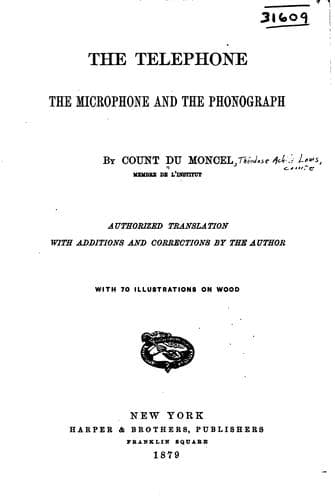
The telephone, the microphone & the phonographDu Moncel, Th., comte
History
The telephone, the microphone & the phonograph
Du Moncel, Th., comte
Microphone; Phonograph; Telephone
In the mode we have described, this telegraphic system only admits
of audible transmissions, and consequently cannot register messages.
To supply this defect, it has been suggested to make the receiving
vibrators react on registers, so arranging the latter that their
electric organ may present such magnetic inertia, that, when it is
influenced by the vibrations of sound, its effect may be maintained
throughout the time of vibration. Experiments show that a Morse
receiver, worked by the current of a local battery, will be enough for
this purpose; so that if the musical vibrator is made to react as a
relay, that is, on a contact in connection with the local battery and
the receiver, the dots and dashes may be obtained on it which are the
constituent elements of the Morse code.
On these principles, and considering that the musical spaces
separating the different notes of the scale are such as may be easily
distinguished by the resonator, seven simultaneous transmissions may be
obtained on the same wire; but experience shows that it is necessary to
be content with a much smaller number. Yet this number may easily be
doubled by applying the mode of transmission in an opposite direction
to the system.
Mr. Bell states that the idea of applying the telephone to multiple
electric transmissions occurred simultaneously to M. Paul Lacour of
Copenhagen, to Mr. Elisha Gray of Chicago, to Mr. Varley of London,
and to Mr. Edison of New York; but there is some confusion here, for
we have already seen, from reference to the patents, that Mr. Varley’s
system dates from 1870, that of M. Paul Lacour from September 1874,
that of Mr. Elisha Gray from February 1875, and those of Messrs.
Bell and Edison were still later. Yet it appears from Mr. Gray’s
specification that he was the first to conceive and execute instruments
of the kind. In fact, in a specification drawn up on August 6, 1874,
he distinctly put forward the system we have described, and which is
the basis of those of which we have still to speak. This specification
was only an addition to two others made out in April and June 1874.
Mr. Varley’s system has only an indirect relation to the one we have
described. It appears from what Mr. Bell said on the subject in a paper
addressed to the Society of Telegraphic Engineers in London, that he
himself only attaches a secondary interest to this invention.
Public-domain text, read in full here on John Shaqi.
Reviews
Reviews
No reviews yet
Be the first to share your thoughts on this work.
Elsewhere in the archive
Join the Discussion
Join the discussion
Sign in to leave a comment or review.
Sign InorCreate an account