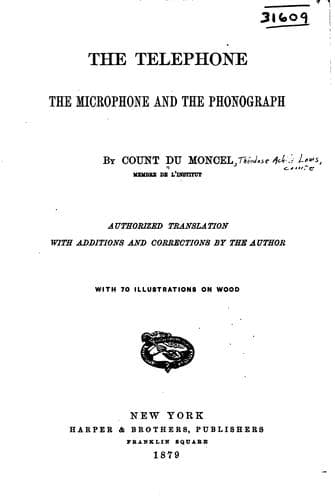
The telephone, the microphone & the phonographDu Moncel, Th., comte
History
The telephone, the microphone & the phonograph
Du Moncel, Th., comte
Microphone; Phonograph; Telephone
He said that he had been struck with the idea that the greater or
less duration of a musical sound might represent the dot and dash of
the telegraphic alphabet, and it occurred to him that simultaneous
telegraphic transmissions, of which the number should only be
limited by the delicacy of the sense of hearing, might be obtained
by suitable combinations of long and short sounds, and that these
should be effected by a keyboard of tuning-forks applied to one end
of a telegraphic line, and so arranged as to react electrically on
electro-magnetic instruments striking on the strings of a piano. For
this purpose it would be necessary to assign an employé to each of
the keys for the service of transmission, and to arrange that his
correspondent should only distinguish his peculiar note among all
those transmitted. It was this idea, Mr. Bell adds, which led to his
researches in telephony.
For several years he sought for the best mode of reproducing musical
sounds at a distance by means of vibrating rheotomes: the best results
were given by a steel plate vibrating between two contacts, of which
the vibrations were electrically produced and maintained by an
electro-magnet and a local battery. In consequence of its vibration,
the two contacts were touched alternately, and the two circuits
were alternately broken; the local circuit which kept the plate in
vibration, and the other which was connected with the line, and reacted
on the distant receiver, so as to effect simultaneous vibrations in
it. A Morse key was placed in the latter circuit near the sending
instrument, and when it was lowered, vibrations were sent through the
line; when it was raised, these vibrations ceased, and it is easy to
see that, by lowering the key for a longer or shorter time, the short
and long sounds necessary for the different combinations of telegraphic
language could be obtained. Moreover, if the vibrating plate of the
receiving instrument were so regulated as to vibrate in unison with the
sending instrument in correspondence, it would vibrate better with this
sender than with another whose plate was not so adjusted.
It is evident that different sounds might be simultaneously transmitted
with several plates by this arrangement of contact breaker, and that
at the receiving station the sounds might be distinguished by each
employé, since the one which corresponds to the fundamental note of
each vibrating plate is reproduced by that plate. Consequently, the
sounds produced by the vibrating plate of _do_, for example, will only
be audible at the receiving station on the plate tuned to _do_, and the
same will be the case with the other plates; so that the sounds will
reach their destination, if not without confusion, yet with sufficient
clearness to be distinguished by the employés.
Public-domain text, read in full here on John Shaqi.
Reviews
Reviews
No reviews yet
Be the first to share your thoughts on this work.
Elsewhere in the archive
Join the Discussion
Join the discussion
Sign in to leave a comment or review.
Sign InorCreate an account