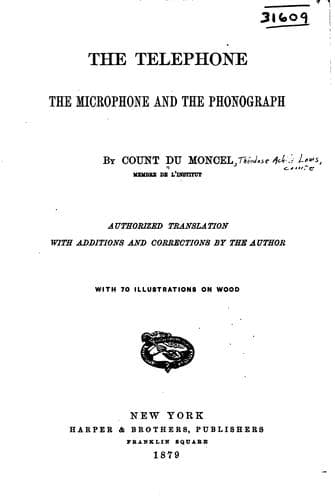
The telephone, the microphone & the phonographDu Moncel, Th., comte
History
The telephone, the microphone & the phonograph
Du Moncel, Th., comte
Microphone; Phonograph; Telephone
_Its application to telegraphic service._--The advantage to be derived
by the telegraphic service from the telephone is rather limited, since,
as far as the speed of transmission is concerned, it is of less value
than many of the telegraphic instruments now in use, and the messages
which it produces cannot be registered. Yet in municipal offices not
overburdened with messages they offer the advantage of not requiring a
trained service. On longer lines their use would be of little value.
The ‘Berne Telegraphic Journal’ has published some interesting remarks
on this subject, of which the following is a summary.
1st. In order to send a message with the special advantages of the
system, the sender ought to be able to address his correspondent
without the intervention of an official. Those who are acquainted with
the network of wires know this to be impossible. Intermediate offices
for receiving messages are essential, and the public cannot be admitted
to those set apart for sending and receiving; consequently the sender
must deliver a written message.
2nd. If the message is written, the chief advantage of the instrument
is lost, since it must be read and uttered aloud, which could not
be done if expressed in a language with which the employés were
unacquainted.
3rd. The instruments now in use at the telegraph offices can transmit
messages more quickly than if they were spoken.
In Germany, however, a telephone service has been established in
several telegraph offices, and its possible advantages are enumerated
as follows in the official circular which created it:
‘The offices which will be opened to the public for the service
of telephonic messages in Germany will be regarded as independent
establishments; yet they will be in connection with the ordinary
telegraph offices, which will undertake to send telephonic messages
through their wires.
‘The transmission will take place as follows: The sending office will
request the receiving office to prepare the instrument; as soon as
the tubes are adjusted, the sending office will give the signal for
despatching the verbal message.
‘The sender must speak slowly and clearly, without raising his voice;
each syllable must be distinctly pronounced; the final syllables
especially must be well articulated, and there must be a pause after
each word, in order to give the receiver time to write it down.
‘When the telegram has been received, the employé at the receiving
office must verify the number of words; then he must repeat through the
telephone the whole message without pausing, so as to make sure that
there is no mistake.
‘In order to ensure secrecy, the telephones are placed apart, where
persons unconnected with the service cannot hear the verbal message,
and the employés are forbidden to reveal to anyone the names of the
correspondents.
‘The charge for telephonic messages, as for the ordinary telegraphic
services, is at the rate of so much a word.’
Public-domain text, read in full here on John Shaqi.
Reviews
Reviews
No reviews yet
Be the first to share your thoughts on this work.
Elsewhere in the archive
Join the Discussion
Join the discussion
Sign in to leave a comment or review.
Sign InorCreate an account