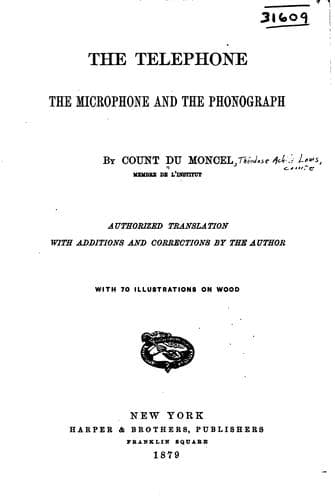
The telephone, the microphone & the phonographDu Moncel, Th., comte
History
The telephone, the microphone & the phonograph
Du Moncel, Th., comte
Microphone; Phonograph; Telephone
The use of the telephone has also been suggested for verifying the
perfect junction of telegraphic wires. It is certain that, if the
junction is complete, no abnormal sounds will be heard, or only those
which result from accidental currents; but if the junction is bad, the
imperfect contacts which take place produce variations in electric
intensity which are translated into the more or less marked sounds
observed in the telephone.
M. Mauborgne, the electrician attached to the Northern Railway of
France, has lately used the telephone instead of the galvanometer to
ascertain the condition of the circuits in correspondence with the
instruments in use for electric signals. The reactions produced on
the galvanometer needle by the pieces of iron which are placed at the
sides of the railway often make its indications uncertain, and a strong
wind produces irregular movements in the instrument which interfere
with observations. It was also necessary to place the galvanometer
with due regard to the points of the compass, and to wait for the
needle to settle, which involved loss of time. The operation is easily
accomplished with the telephone, since the strokes of the call-bell are
distinctly reproduced; it is made to ring by working the contacts which
need verification, and in the same way the condition of the battery can
be ascertained.
_Application to military purposes._--Since the telephone was invented,
numerous experiments have been made in different countries to ascertain
whether it would be of use in military operations. These experiments
have hitherto been only moderately satisfactory, on account of the
noise inseparable from an army, which generally makes it impossible
to hear the telephone, and every means of intensifying its sounds has
been eagerly sought. It was at first supposed that the discovery of
the microphone had solved the problem, and I received many enquiries
from military schools on the subject, but I have not been able to see
that anything has been gained from this point of view. The telephone
is, however, of great use in schools of artillery and rifle practice.
Now that firearms carry so far, it has become necessary to be informed
by telegraph of the points hit on the target, in order to judge of
the accuracy of aim, and for this purpose telegraphic targets were
suggested; but telephones are much to be preferred, and they are now
used with good effect.
If the telephone is unsuited for the service of the flying telegraph in
the field, it may be of great use in the defence of towns, to transmit
the orders of the commandant to different batteries, and even for the
exchange of correspondence with captive balloons sent to hover over
fields of battle.
Public-domain text, read in full here on John Shaqi.
Reviews
Reviews
No reviews yet
Be the first to share your thoughts on this work.
Elsewhere in the archive
Join the Discussion
Join the discussion
Sign in to leave a comment or review.
Sign InorCreate an account