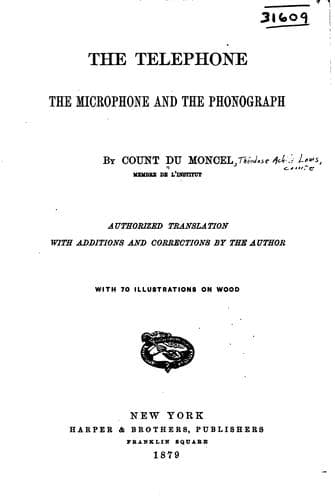
The telephone, the microphone & the phonographDu Moncel, Th., comte
History
The telephone, the microphone & the phonograph
Du Moncel, Th., comte
Microphone; Phonograph; Telephone
After M. Cros, and before Mr. Edison, MM. Napoli and Marcel Deprez
attempted to make a phonograph, but with so little success that they
believed at one time the problem to be insoluble, and threw doubts
on Mr. Edison’s invention when it was announced to the Société de
Physique. They subsequently resumed their labours, and lead us to
hope that they may eventually produce a phonograph of more perfect
construction than that of Mr. Edison. We shall have more to say on this
subject.
In conclusion, the mechanical reproduction of speech was first effected
by Mr. Edison, and in so doing he has accomplished one of the most
curious and important discoveries of our time, since it has shown that
this reproduction was much less complicated than had been supposed. Yet
the theoretical consequences of the discovery must not be exaggerated,
since I do not consider it by any means proved that our theories on the
voice are incorrect. There is in fact a great difference between the
reproduction of a sound which has been uttered, and the mode in which
the same sound was produced. The reproduction may be easily effected,
as M. Bourseul has remarked, as soon as a mode has been discovered of
transmitting the vibrations of air, however complex they may be; but in
order to produce the complex vibrations of speech by the voice, several
special organs must be exercised--first, the muscles of the throat;
secondly, the tongue, the lips, and even the teeth--and for this reason
an articulating machine is necessarily very complex.
Surprise was expressed that the speaking machine, which was brought
from America two years ago, and exhibited at the Grand Hôtel, Paris,
was so extremely complicated, since the phonograph solved the problem
in such a simple way. This is because the latter instrument only
reproduces speech, while the former utters it, and the inventor of
the speaking machine had to employ in his mechanism all the organs
which are necessary in our organism for the reproduction of speech.
The problem was infinitely more complex, and this invention has
not attracted all the attention it deserved. We shall speak of it
presently. We must now describe the phonograph and the different
applications which have been, or which may be, made of it.
Public-domain text, read in full here on John Shaqi.
Reviews
Reviews
No reviews yet
Be the first to share your thoughts on this work.
Elsewhere in the archive
Join the Discussion
Join the discussion
Sign in to leave a comment or review.
Sign InorCreate an account