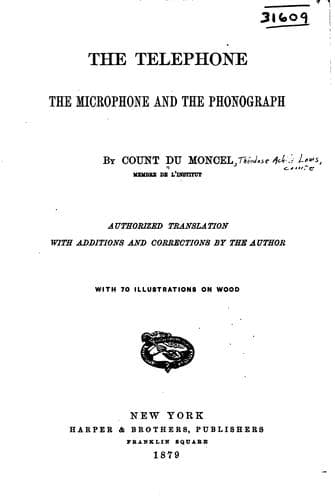
The telephone, the microphone & the phonographDu Moncel, Th., comte
History
The telephone, the microphone & the phonograph
Du Moncel, Th., comte
Microphone; Phonograph; Telephone
In the course of some experiments Mr. Edison was making with the
telephone, a stylus attached to the diaphragm pierced his finger at
the moment when the diaphragm began to vibrate under the influence of
the voice, and the prick was enough to draw blood. It then occurred
to him that if the vibrations of the diaphragm enabled the stylus to
pierce the skin, they might produce on a flexible surface such distinct
outlines as to represent all the undulations produced by the voice, and
even that the same outlines might mechanically reproduce the vibrations
which had caused them, by reacting on a plate capable of vibrating in
the same way as that which he had already used for the reproduction
of the Morse signals. From that moment the phonograph was discovered,
since there was only a step between the idea and its realisation, and
in less than two days the instrument was made and tried.
This is an ingenious story, yet we would rather believe that the
discovery was made in a more serious spirit. In fact, such an inventor
as Mr. Edison, who had discovered the electro-motograph, and had
applied it to the telephone, was already on the way to discover the
phonograph, and we think too well of his powers to attach much credit
to this American romance. Besides, Mr. Edison was well acquainted with
Mr. Scott’s phonautograph.
Mr. Edison’s phonograph was only patented in January 1877.
Consequently, when we look at the principle of the invention, M. Cros
undoubtedly may claim priority; but it is a question whether the
system described in his sealed paper, and published in the _Semaine
du Clergé_, October 8, 1877, would have been capable of reproducing
speech. Our doubt seems justified by the unsuccessful attempts of the
Abbé Leblanc to carry out M. Cros’ idea. When we have to do with such
undulating and complex vibrations as those involved in the reproduction
of articulate words, it is necessary that the stereotyping should in
some sense be effected by the words themselves, and their artificial
reproduction will necessarily fail to mark the slight differences
which distinguish the delicate combinations of speech. Besides, the
movements performed by a point confined to a groove that follows a
sinusoidal curve cannot be effected with all the freedom necessary for
the development of sounds, and the friction exerted on the two edges of
the groove will often be of a nature to stifle them. A distinguished
member of the Société de Physique, when I exhibited the phonograph to
that society, justly said that Mr. Edison’s whole invention consisted
in the thin metallic sheet on which the vibrations are inscribed; this
sheet permits the movements of the vibrating plate to be directly
stereotyped, and thereby the problem is solved. It was necessary to
find such an expedient, and it was done by Mr. Edison, who is therefore
the inventor of the phonograph.
Public-domain text, read in full here on John Shaqi.
Reviews
Reviews
No reviews yet
Be the first to share your thoughts on this work.
Elsewhere in the archive
Join the Discussion
Join the discussion
Sign in to leave a comment or review.
Sign InorCreate an account