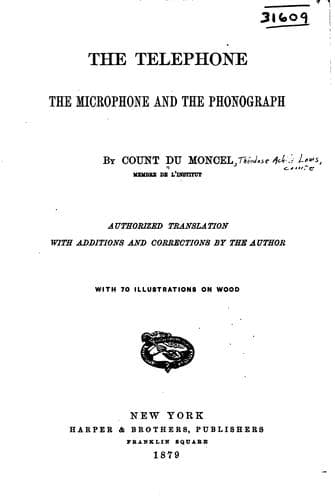
The telephone, the microphone & the phonographDu Moncel, Th., comte
History
The telephone, the microphone & the phonograph
Du Moncel, Th., comte
Microphone; Phonograph; Telephone
As the height of the notes of the musical scale depends on the number
of vibrations effected by a vibrating substance in a given time,
speaking will be reproduced in a tone of which the pitch will depend
on the velocity of rotation given to the cylinder on which the tinfoil
is wound. If the velocity is the same as that which was used in
registration, the tone of the words reproduced is the same as that
in which they were uttered. If the velocity is greater, the tone is
higher; if less, the tone is lower; but the accent of the speaker may
always be recognised. Owing to this peculiarity the reproduction of
songs is nearly always defective in instruments turned by the hand;
they sing out of tune. This is not the case when the instrument is
moved by a well-regulated system of clockwork, and in this way a
satisfactory reproduction of a duet has been obtained.
The words registered on tinfoil can be often reproduced; but the sounds
become fainter and more indistinct at each repetition, since the
tracings in relief are gradually effaced. The reproduction on copper
is more successful, but if intended to be permanent the sheets must
be stereotyped, and in this case the instrument must be differently
arranged.
An attempt has been made to obtain speech from the phonograph by taking
the words registered inversely to their true direction. In this way the
sounds obtained were necessarily quite unlike the words uttered; yet
Messrs. Fleeming Jenkin and Ewing have observed that not only are the
vowels unchanged by this inverse action, but consonants, syllables, and
even whole words may be reproduced with the accent they would have if
spoken backwards.
The sounds produced by the phonograph, although fainter than those of
the voice which produced the registered tracing, are strong enough to
react on the ordinary string telephone, and even on a Bell telephone;
and as in this case the sounds do not go beyond the instrument, and can
only be heard by the person who is using it, it is easy to ascertain
that the sound has not been produced by trickery.
Public-domain text, read in full here on John Shaqi.
Reviews
Reviews
No reviews yet
Be the first to share your thoughts on this work.
Elsewhere in the archive
Join the Discussion
Join the discussion
Sign in to leave a comment or review.
Sign InorCreate an account