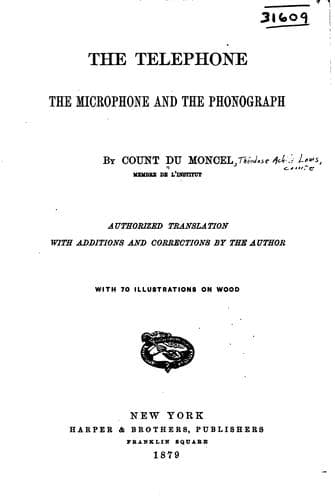
The telephone, the microphone & the phonographDu Moncel, Th., comte
History
The telephone, the microphone & the phonograph
Du Moncel, Th., comte
Microphone; Phonograph; Telephone
Mr. Edison presented his phonograph to the Académie des Sciences
through me, March 11, 1878, and when his agent, M. Puskas, caused
the wonderful instrument to speak, a murmur of admiration was heard
from all parts of the hall--a murmur succeeded by repeated applause.
A letter appeared in the newspapers from one of the persons present,
in which he said that ‘the learned Academy, generally so cold, had
never before abandoned itself to such enthusiasm. Yet some members
of a sceptical turn of mind, instead of examining the physical fact,
ascribed it to moral causes, and a report soon ran through the room
which seemed to accuse the Academy of having been mystified by a
clever ventriloquist. Certainly the spirit of ancient Gaul is still
to be found among the French, and even in the Academy. One said
that the sounds emitted by the instrument were precisely those of a
ventriloquist. Another asked if the movements of M. Puskas’ face and
lips as he turned the instrument did not resemble the grimaces of a
ventriloquist. A third admitted that the phonograph might emit sounds,
but believed that it was much helped by the manipulator. Finally, the
Academy requested M. du Moncel to try the experiment, and as he was not
accustomed to speak into the instrument, it was unsuccessful, to the
great joy of the incredulous. Some members of the Academy, however,
desiring to ascertain the real nature of the effects, begged M. Puskas
to repeat the experiments before them in the secretary’s office under
such conditions as they should lay down. M. Puskas complied with this
request, and they were absolutely satisfied with the result. Yet others
remained incredulous, and it was necessary that they should make the
experiment for themselves before they accepted the fact that speech
could be reproduced in so simple a way.’
The anecdote I have just related cannot be interpreted to the discredit
of the Académie des Sciences, since it is especially bound to preserve
the true principles of science intact, and only to accept startling
facts after a careful examination. Owing to this attitude, all which
emanates from the Academy can be received with complete confidence; and
we cannot approve too highly of reserve which does not give way to the
first impulse of enthusiasm and admiration.
Public-domain text, read in full here on John Shaqi.
Reviews
Reviews
No reviews yet
Be the first to share your thoughts on this work.
Elsewhere in the archive
Join the Discussion
Join the discussion
Sign in to leave a comment or review.
Sign InorCreate an account