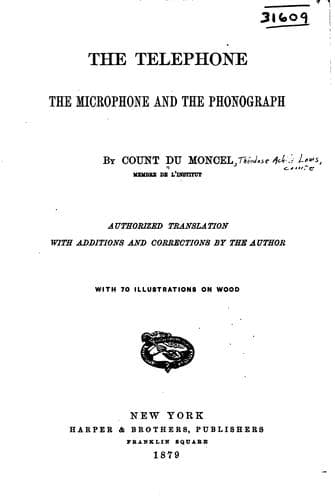
The telephone, the microphone & the phonographDu Moncel, Th., comte
History
The telephone, the microphone & the phonograph
Du Moncel, Th., comte
Microphone; Phonograph; Telephone
Mr. Edison considers that the size of the opening of the mouthpiece has
considerable influence on the distinct articulation of speech. When
the sounds are pronounced before the whole surface of the diaphragm,
some hissing sounds are lost. They are, on the contrary, intensified
when these sounds reach the diaphragm through a narrow orifice with
sharp rims. If the opening is toothed on its flattened rims, the
hissing consonants are delivered more clearly. Speech is reproduced
more perfectly when the mouthpiece has a covering of some thickness,
so arranged as to deaden the sounds arising from the friction of the
tracing point on the tin.
Mr. Hardy has rendered the registration of phonographic tracings more
easy by adding a small ebonite tube, resembling the mouthpiece of a
wind instrument, to the mouthpiece of the phonograph.
USES OF THE PHONOGRAPH AND ITS FUTURE.
Mr. Edison has lately published in the ‘North American Review’ of
May-June 1878 an article on the future of the phonograph, in which he
himself discusses the different applications which may be made of this
instrument. Without sharing all his anticipations, which appear to us
to be very premature, we think that some extracts from his paper may be
interesting.
‘In order to furnish a basis on which the reader may take his stand ...
a few categorical questions and answers are given upon the essential
features of the principle involved.
‘1. Is a vibrating plate or disk capable of receiving a complex motion
which shall correctly represent the peculiar property of each and all
the multifarious vocal and other sound waves?
‘The telephone answers affirmatively.
‘2. Can such complex movement be transmitted from such plate by means
of a single embossing point attached thereto, to effect a record upon a
plastic material, by indentation, with such fidelity as to give to such
indentations the same varied and complex form? And if so, will this
embossing point, upon being passed over the record thus made, follow
it with such fidelity as to transmit to the disk the same variety of
movement, and thus effect a restoration or reproduction of the vocal or
other sound waves, without loss of any property essential to producing
on the ear the same sensation as if coming direct from the original
source?
Public-domain text, read in full here on John Shaqi.
Reviews
Reviews
No reviews yet
Be the first to share your thoughts on this work.
Elsewhere in the archive
Join the Discussion
Join the discussion
Sign in to leave a comment or review.
Sign InorCreate an account