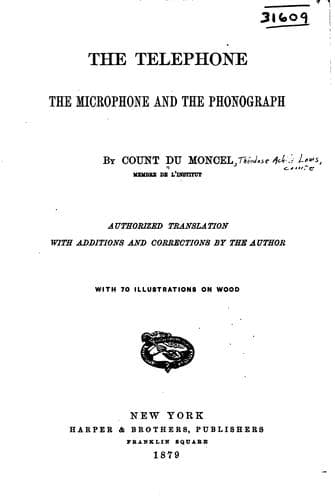
The telephone, the microphone & the phonographDu Moncel, Th., comte
History
The telephone, the microphone & the phonograph
Du Moncel, Th., comte
Microphone; Phonograph; Telephone
‘The answer to this may be summed up in a statement of the fact that
... the writer has at various times during the past weeks reproduced
these waves with such degree of accuracy in each and every detail as
to enable his assistants to read, without the loss of a word, one or
more columns of a newspaper article unfamiliar to them, and which
were spoken into the apparatus when they were not present. The only
perceptible loss was found to be in the quality of the utterance, a
non-essential in the practical application of the instrument. Indeed,
the articulation of some individuals has been perceptibly improved by
passage through the phonograph, the original utterance being mutilated
by some imperfection of lip and mouth formation, and these mutilations
corrected or eliminated by the mechanism of the phonograph.[21]
‘3. Can a record be removed from the apparatus on which it was made,
and replaced upon a second without mutilation or loss of effective
power to vibrate the second plate?
‘This is a mere mechanical detail, presenting no greater obstacle
than having proper regard for the perfect interchangeableness of the
various working parts of the apparatus--not so nice a problem as the
manufacture of the American watch.
‘4. What as to the facility of placing and removing the second sheet,
and as to its transportation by mail?
‘But ten or fifteen seconds suffice for such placing or removing. A
special envelope will probably be required, the weight and form of
which, however, will but slightly increase the cost of postage.
‘5. What as to durability?
‘Repeated experiments have proved that the indentations possess
wonderful enduring power, even when the reproduction has been effected
by the comparatively rigid plate used for their production. It is
proposed, however, to use a more flexible plate for reproducing,
which, with a perfectly smooth stone point--diamond or sapphire--will
render the record capable of from fifty to one hundred repetitions,
enough for all practical purposes.
‘6. What as to duplication of a record and its permanence?
‘Many experiments have been made, with more or less success, in
the effort to obtain electrotypes of a record, and the writer is
informed that it has very recently been successfully accomplished. He
can certainly see no great practical obstacle in the way. This, of
course, permits of an indefinite multiplication of a record, and its
preservation for all time.
‘7. What is the requisite force of wave impinging upon the diaphragm,
and the proximity of the mouth to the diaphragm, to effect a record?
Public-domain text, read in full here on John Shaqi.
Reviews
Reviews
No reviews yet
Be the first to share your thoughts on this work.
Elsewhere in the archive
Join the Discussion
Join the discussion
Sign in to leave a comment or review.
Sign InorCreate an account