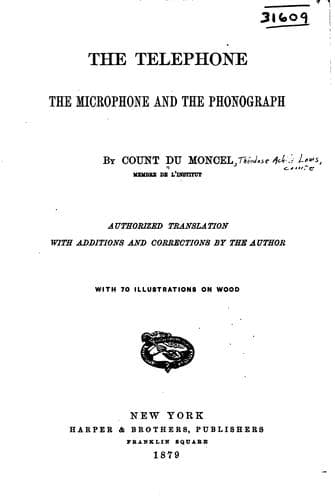
The telephone, the microphone & the phonographDu Moncel, Th., comte
History
The telephone, the microphone & the phonograph
Du Moncel, Th., comte
Microphone; Phonograph; Telephone
‘These depend in great measure upon the volume of sound desired in
the reproduction. If the reproduction is to be made audible to an
assembly, considerable force is requisite in the original utterance;
if for the individual ear, only the ordinary conversational tone (even
a whisper has been reproduced). In both cases the original utterances
are delivered directly in the mouthpiece of the instrument. An audible
reproduction may, however, be had by speaking at the instrument from a
distance of from two to three feet in loud tone. The application of a
flaring tube or funnel to collect the sound waves, and the construction
of an especially delicate diaphragm and embossing point, &c., are the
simple means which suggest themselves to effect this....
‘The foregoing presentment of the stage of development reached by the
several essential features of the phonograph demonstrates the following
_faits accomplis_:
‘1. The captivity of all manner of sound waves, hitherto designated as
“fugitive,” and their retention.
‘2. Their reproduction with all their original characteristics, without
the presence or consent of the original source, and after the lapse of
any period of time.
‘3. The transmission of such captive sounds through the ordinary
channels of commercial intercourse and trade in a material form, for
purposes of communication.
‘4. Indefinite multiplication and preservation of such sounds, without
regard to the existence or non-existence of the original source.
‘5. The captivation of sounds, with or without the knowledge or consent
of the source of their origin...
‘The apparatus now being perfected in mechanical details will be the
standard phonograph, and may be used for all purposes, except such
as require special form of matrix, such as toys, clocks, &c., for
an indefinite repetition of the same thing. The main utility of the
phonograph being, however, for the purposes of letter-writing and
other forms of dictation, the design is made with a view to its utility
for that purpose.
‘The general principles of construction are, a flat plate or disk, with
spiral groove on the face, worked by clockwork underneath the plate;
the grooves are cut very closely together, so as to give a great total
length to each length of surface--a close calculation gives as the
capacity of each sheet of foil nearly 40,000 words. The sheets being
but ten inches square, the cost is so trifling that but a hundred words
might be put on a single sheet economically....
‘The practical application of this form of phonograph is very simple.
A sheet of foil is placed in the phonograph, the clockwork set in
motion, and the matter dictated into the mouthpiece without other
effort than when dictating to a stenographer. It is then removed,
placed in suitable form of envelope, and sent through the ordinary
channels to the correspondent for whom it is designed. He, placing it
upon his phonograph, starts his clockwork, and _listens_ to what his
correspondent has to say.’
Public-domain text, read in full here on John Shaqi.
Reviews
Reviews
No reviews yet
Be the first to share your thoughts on this work.
Elsewhere in the archive
Join the Discussion
Join the discussion
Sign in to leave a comment or review.
Sign InorCreate an account