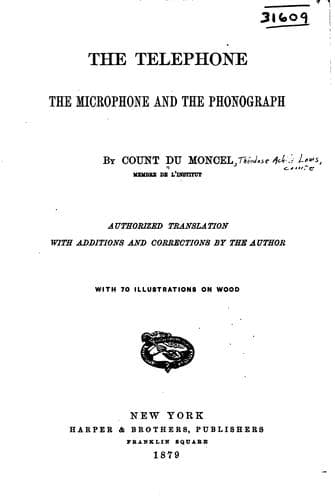
The telephone, the microphone & the phonographDu Moncel, Th., comte
History
The telephone, the microphone & the phonograph
Du Moncel, Th., comte
Microphone; Phonograph; Telephone
[1] Mr. Gray, in an article inserted in the _Telegrapher_ of October
7, 1876, enters into full details of this mode of transmitting sounds
by the tissues of the human body, and he gives the following as the
conditions in which it must be placed to obtain a favourable result: 1.
The electricity must be of a high tension, in order to have an effect
perceptible to the ear.
2. The substance employed to touch the metallic plate must be soft,
flexible, and a good conductor, up to the point of contact: it must
then interpose a slight resistance, neither too great nor too small.
3. The disk and the hand, or any other tissue, must not only be in
contact, but the contact must result from rubbing or gliding over the
surface.
4. The parts in contact must be dry, so as to maintain the required
degree of resistance.
[2] He cites the following names in his account of electric
telephony:--Page, Marrian, Beatson, Gassiot, De la Rive, Matteucci,
Guillemin, Wertheim, Wartmann, Janniar, Joule, Laborde, Legat, Reiss,
Poggendorf, Du Moncel, Delezenne, Gore, &c. Vide Mr. Bell’s paper, in
the _Journal of the Society of Telegraphic Engineers_ in London, vol.
vi. pp. 390, 391.
[3] This statement is disputed by Mr. Elisha Gray, owing, as we shall
see, to a misunderstanding as to the word _undulatory_ current.
[4] _Elisha Gray._ Eng. Pat. Spec. No. 2646, Aug. 1874.
[5] This property has long been known, but not applied. In 1856, in the
second edition of my _Exposé des applications d’Electricité_, I pointed
them out in speaking of the contact-breakers. I also spoke of them in
a paper on electro-magnets (published in the _Annales télégraphiques_,
1865), and in several articles laid before the _Académie des Sciences_
in 1872 and 1875 on the conductivity of filings and conducting powders.
M. Clérac, in 1865, also used them to obtain variable resistances.
[6] In 1865 I was able to verify this observation when tightening the
spirals of an electro-magnet on a naked wire. The greater the number
of spirals under pressure, the more definite were the differences of
resistance in the magnetising helix.
[7] M. Hellesen communicated the plan of his instrument to me on May 3,
1878, and his experiments were made in Copenhagen three weeks earlier.
[8] M. M. J. Page had already noticed that if a telephone is placed
in the circuit of the primary helix of an induction coil, while the
secondary helix of this instrument is placed in the circuit of one of
M. Lippmann’s capillary electrometers, a movement of the mercurial
column of the electrometer takes place at each word, and this movement
is effected towards the capillary end of the tube, in whatever
direction the current is sent by the telephone. This is because the
mercury always tends to move more rapidly at its capillary end than at
the other extremity.
Public-domain text, read in full here on John Shaqi.
Reviews
Reviews
No reviews yet
Be the first to share your thoughts on this work.
Elsewhere in the archive
Join the Discussion
Join the discussion
Sign in to leave a comment or review.
Sign InorCreate an account