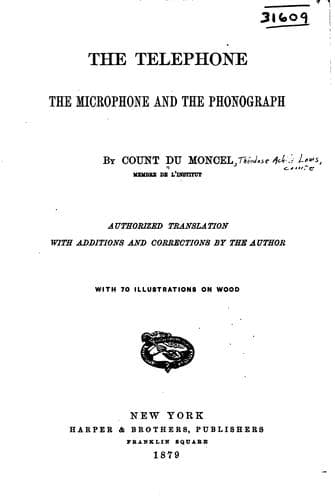
The telephone, the microphone & the phonographDu Moncel, Th., comte
History
The telephone, the microphone & the phonograph
Du Moncel, Th., comte
Microphone; Phonograph; Telephone
If the wire is in contact with masses of metal at each end, the effect
is further increased; but the two masses must not be in metallic
communication with each other, and must be to some extent insulated by
a more or less elastic medium. If the metallic masses are soldered to
the wire, the effects are still greater.
M. Ader was also able to reproduce speech by using a simple coil
without a magnetic core, but in this case the spirals must be open, and
not pressed together. If they are steeped in gum, no sound is heard,
but speech will become instantly audible if a wire or a magnetised
needle is inserted in the coil, or even if a second metallic helix is
placed in the circuit: always provided that one of the ends of these
magnetic organs rests upon, or is fastened to, the board on which the
coil is fixed.
M. Ader has likewise obtained a very distinct reproduction of speech
at a distance of two or three yards from the instrument by inserting
between the two stretched membranes of two tambourines a bent wire
which acts as a spring and passes through an electro-magnetic coil.
Under these conditions, magnetisation of the wire in a greater or less
degree affects its elasticity and causes vibrations which are magnified
by the membranes, and transmitted sounds are reproduced with intensity.
Unfortunately articulate speech is less distinct with this system than
with the one I described before.
M. Ader has often had occasion to make one curious remark, namely,
that the _timbre_ of the voice and its high or low key varies with the
degree of tension given to the wire; but if the fundamental note of
the wire is deadened by pressing it between the fingers, the sounds
reproduced then become dull and monotonous. They are also somewhat
fainter.
Signor Carlo Resio has also observed that in a telephone sender the
variations of intensity in the current correspond with the vibrations
caused by speech, and these are reproduced by corresponding variations
in a liquid column, which may thus act as a telephone receiver,
and consequently may reproduce speech without any electro-magnetic
organ, as in a microphone speaker. Under these conditions, however, a
layer of water is inserted between the platinum electrodes and the
surrounding air, and consequently this liquid layer must be put in
vibration under the influence of varying intensities of current.
Mr. Edison has also now made a practical application of the chemical
telephone we have mentioned before. The trials made with it have been
very satisfactory, showing that sounds transmitted in this way can be
heard in a large room.
PRINTED BY
SPOTTISWOODE AND CO., NEW-STREET SQUARE
LONDON
FOOTNOTES
Public-domain text, read in full here on John Shaqi.
Reviews
Reviews
No reviews yet
Be the first to share your thoughts on this work.
Elsewhere in the archive
Join the Discussion
Join the discussion
Sign in to leave a comment or review.
Sign InorCreate an account