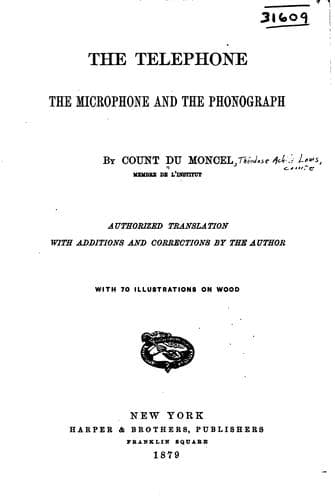
The telephone, the microphone & the phonographDu Moncel, Th., comte
History
The telephone, the microphone & the phonograph
Du Moncel, Th., comte
Microphone; Phonograph; Telephone
[12] Mr. Warwick describes his experiments as follows: ‘The magnets
employed were nearly of the usual size, 1½ inch in diameter, and nearly
eight times as long. At first I employed iron disks, but I found
them to be unnecessary. When I had discarded them, I tried several
substances: first a thin disk of iron, which answered perfectly both
for sender and receiver. A disk of sheet iron, about ⅒ of an inch
in thickness, did not act so well, but all that was said was quite
understood. In making experiments with the disks, I simply placed them
above the instrument, without fixing them in any way: the wooden cover
and the conical cavity were also laid aside, because the transmission
and reception could be effected as well without them. This part of the
instrument seems to be superfluous, since, when the disk is simply
placed level to the ear, the sound seems to be increased by being
brought nearer. Although iron acts better than anything, it appears
that iron disks are not absolutely necessary, and that diamagnetic
substances also act perfectly. I wished that my assistant, who was at
some distance, and could not hear any direct sound, should continue
his calculations. I took away the iron disk and placed across the
instrument a wide iron bar, an inch thick. On applying my ear to it, I
could hear every sound distinctly, but somewhat more faintly. A piece
of copper, three inches square, was substituted for it: although the
sound was still distinct, it was fainter than before. Thick pieces of
lead, zinc, and steel were alternately tried. The steel acted in almost
the same way as the iron, and, as in the other cases, each word was
heard faintly but distinctly. Some of these metals are diamagnetic,
and yet the action took place. Some non-metallic substances were next
tried; first a piece of window-glass, which acted very well. The action
was faint with a piece of a wooden match-box; but on using pieces
of gradually increasing thickness the sound was sensibly increased,
and with a piece of solid wood, 1½ inch in thickness, the sound was
perfectly distinct. I next replaced it by an empty wooden box, which
acted very well. A piece of cork, ½ inch thick, acted, but somewhat
faintly. A block of razor-stone, 2 inches thick, was placed upon the
instrument; and, on applying the ear to it, it was quite easy to
follow the speaker. I then tried to hear without the insertion of any
substance, and, on applying my ear quite close to the coil and magnet,
I heard a faint sound, and on listening attentively I understood all
that was said. In all these experiments the sounds were perceived,
but the sounds transmitted or attempted did not act precisely alike.
The sound of a tuning-fork, placed on the iron disk itself or on
the case of the instrument, was clearly heard: thin iron disks were
more effective for articulate speech. With other substances, stone,
solid wood, glass, zinc, &c., the sound of the tuning-fork was heard,
Public-domain text, read in full here on John Shaqi.
Reviews
Reviews
No reviews yet
Be the first to share your thoughts on this work.
Elsewhere in the archive
Join the Discussion
Join the discussion
Sign in to leave a comment or review.
Sign InorCreate an account