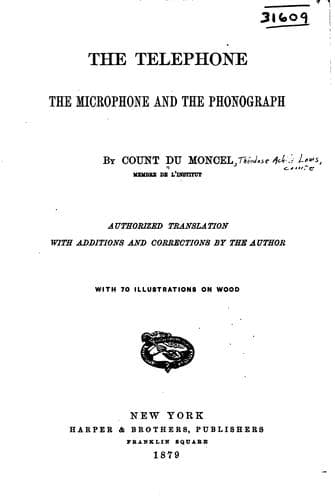
The telephone, the microphone & the phonographDu Moncel, Th., comte
History
The telephone, the microphone & the phonograph
Du Moncel, Th., comte
Microphone; Phonograph; Telephone
whether it rested upon them, or the vibrating fork was held above
them. These substances were not adapted for transmitting the sound
of the voice. These were all laid aside, and the sounding instrument
was held directly above the pole of the magnet: the sound was clearly
heard, although there was nothing but air between the end of the
magnet and the tuning-fork. The sound was perhaps less intense when
the tuning-fork was held directly above the pole, than when it was at
the end of the magnet. I next tried if my voice could be heard with
this arrangement. The result was rather doubtful, but I think that
some action must have taken place, for the tuning-fork was heard when
it was simply vibrated near the pole. The effect of the voice can only
have differed in the degree of intensity: it was too faint to be heard
at the other extremity. I repeated these effects; I assured myself of
them, and I succeeded in transmitting sounds distinctly on the pole
without a disk, and, on the other hand, by applying my ear to the
instrument, I was able to hear distinctly all that was said, although
there was no disk.’
[13] These are his own words: ‘The articulation produced from the
instrument was remarkably clear, but its great defect consisted in the
fact that it could not be used as a sending instrument, and thus two
telephones were required at each station, one for transmitting and one
for receiving spoken messages.’
[14] These carbons are made by heating, in a temperature gradually
raised to white heat, fragments of deal of a close fibre, which is
enclosed in an iron tube or box hermetically sealed.
[15] Mr. Willoughby Smith varied this experiment by placing a packet
of silk threads coated with copper on the disconnected ends of the
circuit, which were arranged at right angles with each other. Under
these conditions the instrument became so sensitive, that the current
of air produced by a lamp placed above the system, caused a decided
crackling noise in the telephone.
[16] Mr. Hughes observes on this subject that carbon is a valuable
material for such purposes, since it does not oxidise, and its effects
are greater when combined with mercury. He takes the prepared charcoal
used by artists, brings it to a white heat, and suddenly plunges it in
a bath of mercury, of which the globules instantly penetrate the pores
of charcoal, and may be said to metallise it. He also tried charcoal
coated with a deposit of platinum, or impregnated with chloride of
platinum, but this was not more successful than the former method. If
the charcoal of fir-wood is brought to a white heat in an iron tube,
containing tin and zinc, or any other metal which readily evaporates,
it is metallised, and is adapted for use if the metal is subdivided in
the pores of charcoal and not combined with it. When iron is introduced
into carbon in this way it is one of the most effective metals. The
charcoal of fir-wood, in itself a bad conductor, may thus acquire great
conducting power.
Public-domain text, read in full here on John Shaqi.
Reviews
Reviews
No reviews yet
Be the first to share your thoughts on this work.
Elsewhere in the archive
Join the Discussion
Join the discussion
Sign in to leave a comment or review.
Sign InorCreate an account