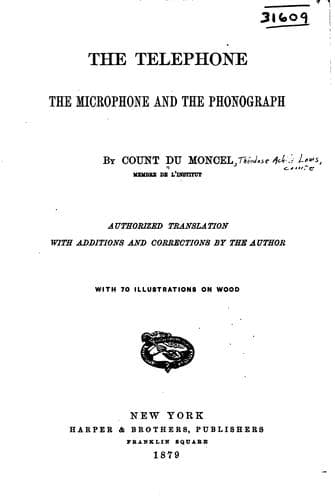
The telephone, the microphone & the phonographDu Moncel, Th., comte
History
The telephone, the microphone & the phonograph
Du Moncel, Th., comte
Microphone; Phonograph; Telephone
‘By a well-known photographic process a transparent tracing of the
undulations of the spiral can be represented by a line of similar
dimensions on some resisting substance, tempered steel for example.
‘When this is done, this resisting surface is placed in a turning
machine which causes it to revolve and advance with a velocity and
motion similar to those by which the registering surface was actuated.
A metallic point if the tracing is concave, or a grooved index if it
is in relief, is kept upon the tracing by a spring, and the index
which supports this point is connected with the centre of the membrane
which produces the sounds. Under these conditions, the membrane will
be actuated not by the vibrating air, but by the tracing which guides
the index, and the impulses will be precisely similar in duration and
intensity to those to which the registering membrane was subjected.
‘The spiral tracing represents equal successions of time by increasing
or decreasing lengths. There is no inconvenience in this, since the
turns of the spiral are very close together, if only the circumference
of the turning circle is used; but then the central surface is lost.
‘In all cases the tracing of the helix on a cylinder is much more
satisfactory, and I am now trying to make this idea practicable.’
[20] Never make a contact between the stylus and the cylinder until the
latter is covered with the tinfoil. Do not begin to turn the cylinder
until assured that everything is in its place. Take care, when the
stylus returns to the point of departure, to bring the mouthpiece
forward. Always leave a margin of from five to ten millimètres on the
left and at the beginning of the sheet of tinfoil; for if the stylus
describes the curve on the extreme edge of the cylinder, it may tear
the sheet or come out of the groove. Be careful not to detach the
spring of the caoutchouc pad.
To fix the tinfoil, apply varnish to the end with a paint-brush; take
this end between the finger and thumb of the left hand, with the sticky
part towards the cylinder; raise it with the right hand and apply it
quite smoothly to the cylinder; bring round the sticky end, and join
them firmly.
To adjust the stylus and place it in the centre of the groove, bring
the cylinder to the right, so as to place the stylus opposite the
left extremity of the tinfoil; bring forward the cylinder gently and
by degrees, until the stylus touches the tinfoil with force enough to
imprint a mark. Observe if this mark is quite in the centre of the
groove (in order to do this, make a mark with the nail across the
cylinder), and if it is not, adjust the stylus to the right or left by
means of the little screw placed above the mouthpiece. The depth of the
impression made by the stylus should be ⅓ millimètre, just enough for
it to leave a slight tracing, whatever the range of vibrations may be.
Public-domain text, read in full here on John Shaqi.
Reviews
Reviews
No reviews yet
Be the first to share your thoughts on this work.
Elsewhere in the archive
Join the Discussion
Join the discussion
Sign in to leave a comment or review.
Sign InorCreate an account