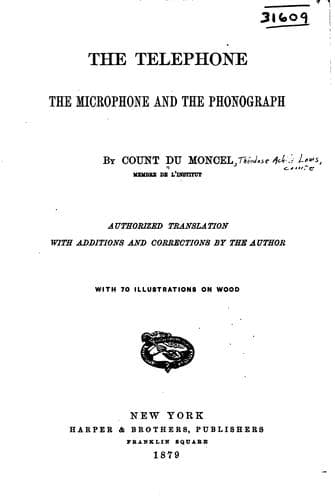
The telephone, the microphone & the phonographDu Moncel, Th., comte
History
The telephone, the microphone & the phonograph
Du Moncel, Th., comte
Microphone; Phonograph; Telephone
[17] Mr. Hughes remarks that the vibrations which affect the
microphone, even in speaking at a distance from the instrument, do
not proceed from the direct action of the sound waves on the contacts
of the microphone, but from the molecular vibrations produced by it
on the board which serves to support the instrument; he shows, in
fact, that the intensity of sounds produced by the microphone is in
proportion to the size of the surface of this board, and when the
sending microphone is enclosed in a cylindrical case, its sensitiveness
is not much diminished if the surface of the box enclosing the whole is
sufficiently large. From this point of view he has sought to increase
the sensitiveness of his instruments by fixing the frame on which the
moveable parts of the sender and receiver revolve on a spring plate.
[18] Helmholtz’s resonator is based upon the principle that a volume
of air contained in an open vase emits a certain note when placed in
vibration, and that the height of the note depends on the size of the
vase and of its opening. Helmholtz makes use of a globe with a large
opening on one side and a small one on the other, and the small one is
applied to the ear. If a series of musical notes take place in the air,
the one which is in harmony with the fundamental note of the globe is
intensified, and can be distinguished from the rest. The same effect
takes place when, on singing to a piano accompaniment, some strings are
heard to vibrate more strongly than others, namely, those which vibrate
in unison with the sounds emitted. The resonators are made in various
ways; those most generally used are cases of different lengths which
also serve as sounding-boxes.
[19] I give the text of M. Cros’ sealed paper, opened by his request,
at the Académie des Sciences, December 3, 1877:--‘Speaking generally,
my process consists in obtaining traces of the movement to and fro of
a vibrating membrane, and in using this tracing to reproduce the same
movements, with their intrinsic relations of duration and intensity,
either on the same membrane or on one adapted to give out the sounds
which result from this series of movements.
‘It is therefore necessary that an extremely delicate tracing, such as
may be obtained by passing a needle over a surface blackened by fire,
should be transformed into a tracing, capable of sufficient resistance
to guide an index which will transmit its movements to the membrane of
sound.
‘A light index is fastened to the centre of a vibrating membrane; it
terminates in a point (a metallic wire or tip of a feather) which rests
on a surface which has been blackened by fire. This surface forms part
of a disk, to which the double action of rotation and rectilinear
progression has been given. If the membrane is at rest, the point
will trace a simple spiral; if the membrane vibrates, there will be
undulations in the spiral, and these undulations will represent the
precise movements of the membrane in their duration and intensity.
Public-domain text, read in full here on John Shaqi.
Reviews
Reviews
No reviews yet
Be the first to share your thoughts on this work.
Elsewhere in the archive
Join the Discussion
Join the discussion
Sign in to leave a comment or review.
Sign InorCreate an account