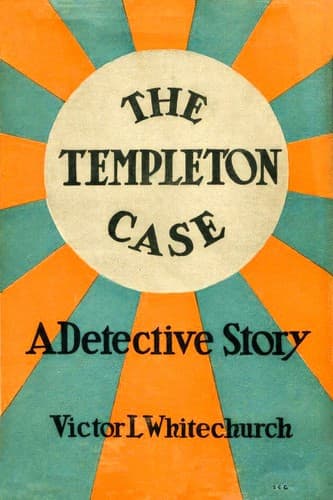
The Templeton caseWhitechurch, Victor L. (Victor Lorenzo)
General
The Templeton case
Whitechurch, Victor L. (Victor Lorenzo)
Detective and mystery stories; Murder -- Investigation -- Fiction; Police -- England -- Fiction
The Templeton Case
by Victor L. Whitechurch
published by Edward J. Clode, Inc. (New York)
CONTENTS
I. Reginald Templeton Comes to Marsh Quay
II. The Visit to the Opposite Shore
III. A Terrible Discovery
IV. What Canon Fittleworth Found on the “Firefly”
V. Detective-Sergeant Colson Discovers Clues
VI. Colson is Baffled
VII. The Inquest
VIII. Winnie Cotterill Pays a Visit to Frattenbury
IX. The Cigar Band
X. Harold Grayson is Detained
XI. The Canon’s Cigars
XII. Fresh Evidence
XIII. Isaac Moss Explains
XIV. Reginald Templeton’s Letter
XV. Detective-Sergeant Colson’s Deductions
XVI. Mr. Proctor Upsets Matters
XVII. New Theories
XVIII. Sir James Perrivale’s Story
XIX. Colson Makes an Appointment
XX. Colson’s “Imagination”
XXI. Final Solution of the Problem
CHAPTER I
Reginald Templeton Comes to Marsh Quay
Tom Gale leaned heavily on the low bulwarks of the little schooner
_Lucy_, his arms folded upon the aforesaid bulwarks, his short, black
clay pipe in his mouth, and his eyes fixed on the flowing tide
glittering in the sunlight of a clear October day.
Tom Gale had nothing whatever to do, and was doing it well, lounging
and thinking, for the most part, about nothing at all. He combined the
offices of crew and cook of the little coasting schooner that was
moored at the head of Marsh Quay, waiting for a load of gravel that
was delayed. That very morning word had been brought that the
contractor would not be able to cart the gravel from the pit, about
three miles away, down to Marsh Quay until the following Tuesday. This
was Saturday, and the “captain” and “mate” had incontinently taken
themselves off to their respective homes at Frattenbury, leaving Tom
Gale in charge.
Tom Gale did not in the least mind having nothing to do beyond taking
care of a vessel that nobody was likely to run away with. There was
good beer to be had at the “Mariner’s Arms,” not a hundred yards away,
and there was a nice snug bar parlour in the “Mariner’s Arms,” where
the evenings might be spent in comfort—for there was no risk in
deserting the vessel for an hour or two.
Marsh Quay was on one of the little estuaries of the sea that pierced
into the southern country from the Channel. Two miles northward, the
grey, tapering spire of the Cathedral of Frattenbury stood out against
the background of Downs and blue sky. The estuary, which ran up within
a mile of Frattenbury to the westward, was at Marsh Quay only about
two hundred yards in width, but broadened out southward until a curve
hid its course towards the open sea.
Marsh Quay, as its name implied, was a little quay jutting out into
the estuary from the eastern shore. It was only about fifty yards
long, but fairly broad, and contained sheds for storage on either
side, except at the end, where it was quite open for a space, which
formed room for a small vessel to be moored on either side, as well as
one at its extremity.
Public-domain text, read in full here on John Shaqi.
Reviews
Reviews
No reviews yet
Be the first to share your thoughts on this work.
Join the Discussion
Join the discussion
Sign in to leave a comment or review.
Sign InorCreate an account