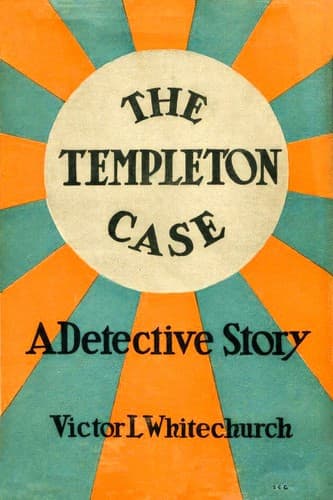
The Templeton caseWhitechurch, Victor L. (Victor Lorenzo)
General
The Templeton case
Whitechurch, Victor L. (Victor Lorenzo)
Detective and mystery stories; Murder -- Investigation -- Fiction; Police -- England -- Fiction
“You’ve heard what Major Renshaw said,” replied Norwood. “Anything I
say may incriminate me. I have no desire to discuss the matter further
at this point.”
“We owe you a further explanation, Canon, as you say,” remarked the
Chief Constable, “and with your permission, Colson shall remain—and
Mr. Grice.”
The Canon nodded.
“Thank you,” he said. “They may stay.”
“Come!” said the superintendent. Between him and the Chief Constable
the coroner walked out of the room, and a motor was heard a few
moments later. Canon Fittleworth sat down and buried his head in his
hands. Presently he said:
“I’m thankful my wife and daughter are not at home.”
“It wouldn’t have happened here, sir, if they had been, I assure you.
You told me, you know, that you were alone.”
The Canon nodded.
“Go on,” he said. “I want to hear it all—poor Reginald!”
“It’s a long story, sir, but I’ll try to make it as short as possible.
The first idea that set me on the right track was that the murderer
was a left-handed man. I found out that Mr. Templeton did not walk
with a stick—I mean, didn’t put the point to the ground. There were
square tracks of the stick’s ferrule on the path to Marsh Quay, on the
left side as you go out.”
“But what made you suspect the stick had anything to do with it?”
Colson told him how the dummy one had been removed on the night after
the murder, and then went on.
“I was on the look-out for a left-handed man, and one day I saw Mr.
Norwood draw a cork from a bottle. He held the bottle with his right
hand and drew it with his left. It seemed preposterous, but when I
noticed him another day walking down the street with a stick in his
left hand it set me thinking. I got the report of the inquest, and
studied it carefully, noting all the coroner’s questions. And it
seemed to me that he was particularly anxious to find out whether
anyone had an idea as to your cousin’s appointment. Also, when Jim
Webb mentioned that he had read the address on the letter to you, he
questioned him narrowly as to whether he had read any other addresses.
Then he must have felt secure until you produced that cigar band. I
thought for a long time that Proctor had changed it, but when I found
he hadn’t, I knew it could only have been the coroner himself.”
“Why?”
“There were several old bands off cigars that had been smoked by
Grayson, lying in the grate. Don’t you remember that the coroner
dropped some papers in the grate, and stooped down to get them? So did
Proctor. That’s why I suspected him first. Afterwards I saw it all.
While that cigar band was passing round the jury, the coroner picked
up one from the grate and changed it. Clever! But it was a foolish
thing to do, as it turned out.
“You told me you gave a dozen of your cigars to the Dean. He
remembered that when Norwood was dining with him afterwards—just a day
or two before the murder—he smoked one of them, and liked it so much
that the Dean gave him a couple, which he put in his case.
Public-domain text, read in full here on John Shaqi.
Reviews
Reviews
No reviews yet
Be the first to share your thoughts on this work.
Elsewhere in the archive
Join the Discussion
Join the discussion
Sign in to leave a comment or review.
Sign InorCreate an account