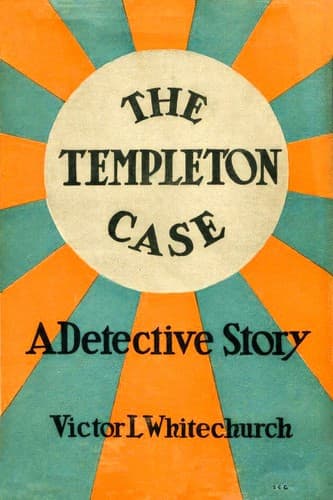
The Templeton caseWhitechurch, Victor L. (Victor Lorenzo)
General
The Templeton case
Whitechurch, Victor L. (Victor Lorenzo)
Detective and mystery stories; Murder -- Investigation -- Fiction; Police -- England -- Fiction
“Well, in Norwood’s hall, when I went to see him one day, I noticed
several queer photographs and old weapons—three or four small daggers
among them—hanging on the wall. Then Mr. Crosby was a great help; he
put me on the track of finding Ezra Grice. There was a letter partly
blotted on Mr. Templeton’s blotting-pad that gave us the clue. And Mr.
Crosby also found out the beginning of the whole story, and
accidentally discovered that the coroner was speculating heavily—and
that had a lot to do with things. He wanted money.”
“Dear me,” said the Canon. “I imagined him to be a wealthy man.”
“So did most people, sir, but after what we heard we made inquiries,
and found out a lot about him. And I assure you that even if I hadn’t
arrested him to-night, he’d very soon have been in the bankruptcy
court.”
“You astonish me.”
“It’s true, sir. Now, when our friend Ezra Grice here arrived from
South Africa, he solved the rest of the mystery. We have his sworn
statement. Will you tell the Canon, Mr. Grice?”
Grice, who had not spoken hitherto, said:
“Yes, I will. Where shall I begin?”
“At the beginning—twenty years ago.”
“You’ll find it a strange story, sir,” said Colson. “And it will
explain why I said the law would have called your cousin a
blackmailer.”
CHAPTER XXI
Final Solution of the Problem
It was an extraordinary story that Ezra Grice had to tell. Briefly,
the first part of it amounted to this. Twenty years ago he had been
clerk in Francis Norwood’s office. Norwood, at that time, had a
partner, a young married man named Forbes. Forbes was tried on a
charge of embezzlement, and Grice was a witness for the prosecution.
But Grice was deeply involved himself. Addicted to betting, he had
helped himself to the firm’s money—falsifying accounts.
Just before the trial commenced he made a discovery—a discovery that
would have proved Forbes an innocent man. And the discovery he made
was that Norwood himself, who had been speculating heavily, had
embezzled the money from two clients—and not Forbes at all. Knowing
this, he went into Norwood’s private office and accused him of the
crime.
But Norwood turned the tables on him. To Grice’s horror, he calmly
produced proofs of the clerk’s defalcations, and threatened to give
him in charge instantly.
“And who is going to believe you _then_?” he asked calmly. “Do you
think they’ll take the word of a thief against mine?”
Grice, who had no proofs in his possession at the time, but had only
arrived at his conclusions by a study of accounts and documents
passing through his hands, was staggered. He felt he had matched
himself unwisely against the astute lawyer—who was quick to see this.
“Very well,” Norwood had said, “you can take your choice. Either I
send for a policeman at once, or you withdraw what you say, and give
your evidence to-morrow. Which is it to be? I give you five minutes to
decide.”
Public-domain text, read in full here on John Shaqi.
Reviews
Reviews
No reviews yet
Be the first to share your thoughts on this work.
Elsewhere in the archive
Join the Discussion
Join the discussion
Sign in to leave a comment or review.
Sign InorCreate an account