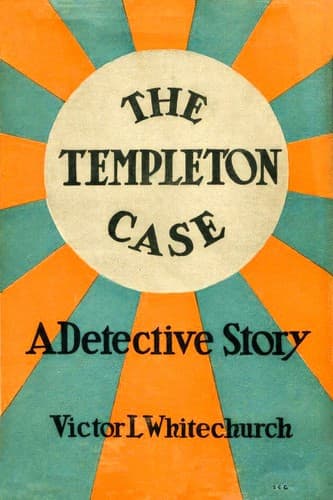
The Templeton caseWhitechurch, Victor L. (Victor Lorenzo)
General
The Templeton case
Whitechurch, Victor L. (Victor Lorenzo)
Detective and mystery stories; Murder -- Investigation -- Fiction; Police -- England -- Fiction
“That depends on what the Chief Constable says, Mr. Norwood—when I’ve
made my report to him. But we like, if we can, to get the credit of a
case like this ourselves. And I’ve great confidence in Colson.
However, developments will probably answer your question.”
“Exactly. It’s no affair of mine of course. But I hope you’ll take
every step to find the murderer.”
“You can trust us for that,” replied the other as he rose to go. “Two
o’clock to-morrow, then?”
“Two o’clock to-morrow, Superintendent,” repeated the coroner. “I’ll
be there.”
He accompanied the policeman out of the room and through a big square,
stone-paved hall to the front door, shaking hands with him stiffly and
limply as he left.
A few minutes later, the superintendent was driving Canon Fittleworth
to Marsh Quay. As they reached the spot, he pointed out the _Firefly_.
“Dear me,” said the Canon, “we were to have come over for a sail in
her to-morrow. How terribly sad!”
When they arrived on the yacht they found Colson sitting on deck,
smoking. He hardly looked at them. The superintendent, who knew his
man, took the Canon into the little saloon. The body had been laid on
the table ready for removal; a handkerchief was over the face.
Canon Fittleworth lifted it reverently.
“Poor fellow!” he exclaimed; “it’s Reginald Templeton, of course—poor
fellow!”
He was almost breaking down. The superintendent, a sympathetic and
sensitive man himself, said:
“I’m going to speak to Colson, sir.”
The other nodded. When he was alone he kneeled down, bowed his head,
and prayed silently for a few minutes. Then, without rising, he looked
about him mechanically.
At times of great stress the smallest objects are often noticeable. An
instance of this strange truth occurred just then. The Canon’s gaze
fell on something lying on the floor of the cabin—partly bright red
and partly shining. With a sort of muffled curiosity, he stooped and
picked it up. It was a cigar band.
Now there is nothing particularly striking in a cigar band. It is a
common enough object. True, cigar bands vary in their queer little
heraldic designs and miniature shields, and inscriptions of the firms
that produced them, in Spanish. But, as the Canon looked at that torn
object, he suddenly started.
“That’s queer,” he murmured, smoothing it out and regarding it
intently. He took off his glasses, wiped them with his handkerchief,
and had another look. His brow puckered. Again he said:
“Queer—very queer.”
Public-domain text, read in full here on John Shaqi.
Reviews
Reviews
No reviews yet
Be the first to share your thoughts on this work.
Join the Discussion
Join the discussion
Sign in to leave a comment or review.
Sign InorCreate an account