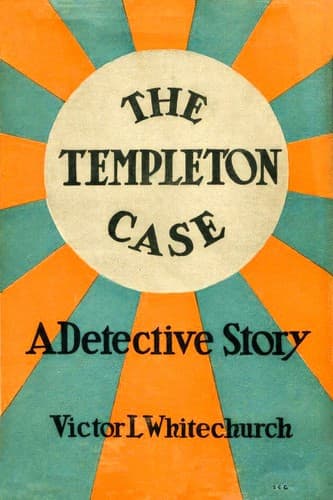
The Templeton caseWhitechurch, Victor L. (Victor Lorenzo)
General
The Templeton case
Whitechurch, Victor L. (Victor Lorenzo)
Detective and mystery stories; Murder -- Investigation -- Fiction; Police -- England -- Fiction
“I knew it! Well, now, when I come back this evening I don’t want
anyone to know I’m here. You put some supper up in my room—show me now
how I can get up to it without being seen—and if anyone asks where I
am, you can tell them the truth, that I’m gone into Frattenbury, see?”
Mrs. Yates, who was almost trembling with excitement, showed him how
he could get in by a back door she would leave unlatched. She also
showed him a shed where he could put his bicycle.
“And one other thing, Mrs. Yates,” he said; “you’re going to keep your
mouth shut, but you must keep your ears open. You’re sure to have men
in to-night discussing the murder. If you hear them say anything about
having seen Mr. Templeton—or any strangers about—you make a note of it
and let me know.”
“I will, sir. I’ll do what I can.”
Colson took his hat and stick and a dispatch-case which he had brought
over in the morning.
When he got outside the inn he walked over to Constable Gadsden, who
was still on the spot. Quite a number of people were about, for the
news had spread rapidly, and anything so gruesome as the central scene
of a murder is attractive.
“Well, Gadsden,” said he, drawing him to one side, “you haven’t let
anyone go on board the yacht—no newspaper men, or anyone?”
The burly policeman grinned.
“Trust me for that, sergeant.”
“Mind you don’t. I’m going into Frattenbury now. I’ll send a man out
to relieve you.”
“Thank you, sergeant. I’ve found out something since I saw you.”
“What?”
The policeman opened his pocket-book. No self-respecting constable
ever reports to a superior officer without a reference to this
mysterious compendium.
“Man o’ the name o’ Simmonds—George Simmonds—lives in the cottage
yonder—states that he was walking along the field path yesterday and
met a man of the description o’ Mr. Templeton going into
Frattenbury—between half-past five and six.”
“May be useful,” replied the detective. “More useful still, though, if
he’d seen him coming back. If there’s anything else to report you can
do so to the superintendent when you get back to Frattenbury.”
He himself took the field path to Frattenbury, and not the road. For
half a mile or so the path ran by the side of the estuary, separated
from the shore by a low hedge. Then, just as one got over a stile, it
turned abruptly and led through a series of marshy meadows. There had
been rain a few days before, and in places the path was damp, showing
a number of footprints.
Just by one of the stiles was a particularly impressionable bit of
ground. The stile had a high step, from which one naturally jumped and
left well-defined footprints. Colson seated himself on the stile,
opened his dispatch-case, and drew out a shoe. Then he got down into
the path and investigated all the footprints narrowly, testing them by
measuring them and comparing the results with the shoe.
Public-domain text, read in full here on John Shaqi.
Reviews
Reviews
No reviews yet
Be the first to share your thoughts on this work.
Join the Discussion
Join the discussion
Sign in to leave a comment or review.
Sign InorCreate an account