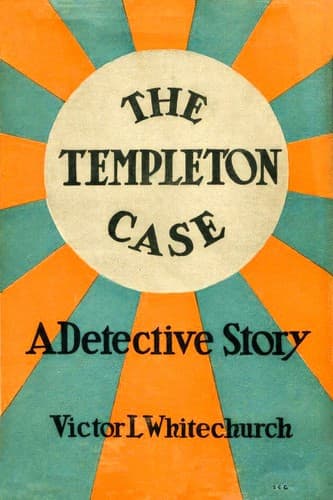
The Templeton caseWhitechurch, Victor L. (Victor Lorenzo)
General
The Templeton case
Whitechurch, Victor L. (Victor Lorenzo)
Detective and mystery stories; Murder -- Investigation -- Fiction; Police -- England -- Fiction
“I made a pretty searching examination,” he said, “but I’m afraid
there are not many results so far. The lockers and portmanteau mostly
contained clothes—and some money. There’s only one letter—and there
weren’t many—that seemed to bear on the case, and it isn’t signed.
Here it is, in an envelope with the Frattenbury postmark, posted to
the G.P.O., Ryde. And it’s typewritten.”
The letter proved to be a half-sheet of nondescript notepaper, with
the words:
“I shall be at home to discuss matters if you will call next
Saturday evening after 8.30—not later than 9.”
That was all. A grim smile lit up the face of the Chief Constable as
he read it, shaking his head.
“That’s not much help,” he said. “Of course it’s the appointment Canon
Fittleworth spoke of. What next?”
The detective produced a blotting-pad.
“There’s not much here,” he said, “but if you hold it before a
looking-glass you can make out what I think to be bits of two
letters.”
Across the top of the blotter, by holding it in front of the glass
portions of words appeared as follows:
e y u on turd ft on,
and then the signature, freshly blotted and quite plain:
Y rs f ithfully,
R. Templeton.
“‘See you on Saturday afternoon,’” said the superintendent. “That
ought to be plain enough. It looks like his appointment with Moss. We
know he went there.”
“That’s it,” said the detective. “Now try the other. That’s a
puzzler.”
For some time the two men scrutinised the blotting-paper. The ink
marks were faint and broken, and in most cases only isolated letters,
or bits of words. Finally, they agreed with Colson that the result was
this:
a d ver zr ice s o ion & roo
s is nal
“Well,” said the Chief Constable, “you’ll be a smart fellow if you
make anything out of _that_—even if it’s worth anything. What next?”
“I went through his pockets. There were no papers of any kind in them.
That looks suspicious. A gentleman in his position would hardly go
about without a pocket-book or something. There was loose cash in the
trousers pockets—and in the waistcoat pocket I found this.”
He produced a very small bag of chamois leather, with a loose string
tied to it to fasten it.
“Look!” he said, as he shook something out on the table.
The two men started. A brilliant coruscation of light flashed before
them. It was a diamond the size of a pea.
“Uncut,” said the Major, as he took it up to examine it; “in the rough
at present, but still brilliant. It’s worth a heap of money. And he
came from South Africa? Where are the rest?”
“Ah,” said the superintendent, “and where does Moss come in?”
“There’s something else,” said Colson, “and I’m not sure whether it
may not be the best clue of all—if we can find the owner of it.”
And he laid the two walking-sticks on the table.
Public-domain text, read in full here on John Shaqi.
Reviews
Reviews
No reviews yet
Be the first to share your thoughts on this work.
Join the Discussion
Join the discussion
Sign in to leave a comment or review.
Sign InorCreate an account