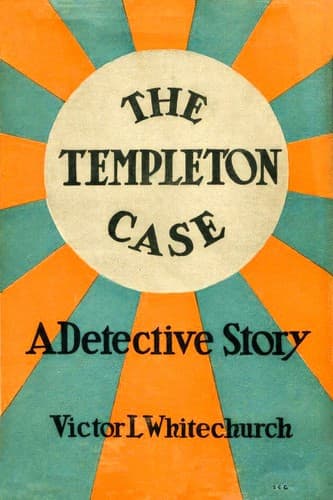
The Templeton caseWhitechurch, Victor L. (Victor Lorenzo)
General
The Templeton case
Whitechurch, Victor L. (Victor Lorenzo)
Detective and mystery stories; Murder -- Investigation -- Fiction; Police -- England -- Fiction
“You say that the deceased had arranged to go into Frattenbury on the
Saturday afternoon?”
“Yes, sir.”
“And that you were given the night off?”
“Yes, sir.”
“Tell me, did you know whom he was going to see?”
“The Reverend Fittleworth, sir. I guessed it afterwards.”
The coroner elevated his eyebrows.
“_Guessed_ it? What do you mean? How did you guess it?”
The man explained that he had read Canon Fittleworth’s name and
address on the letter he had posted for his master.
“Were you in the habit of prying into Mr. Templeton’s correspondence?”
asked the coroner sarcastically.
Jim Webb reddened.
“No, sir, I wasn’t,” he replied emphatically.
“Oh! How many more names and addresses did you read?”
“Not any, sir. As a matter of fact that was the only letter he ever
gave me to post.”
“You’re sure? Remember you are on oath.”
“Quite sure, sir.”
“Very well.”
Anthony Crosby interposed just as Webb was about to stand down.
“May I put a question to the witness?”
“Yes—if you wish. It should be done through me.”
“Thank you, sir. Will you ask him if he can give an account of his
actions from Saturday evening till Sunday morning?”
“You hear the question,” said the coroner to Webb; “what have you to
say?”
“Of course I can,” said the man, a little indignantly. “I was in my
uncle’s house at Frattenbury. I can bring three witnesses to prove
that.”
“Are you satisfied?” the coroner asked Crosby.
“Perfectly, thank you.”
“You ought to be grateful for that question,” said the coroner to
Webb, who was muttering something; “it clears you in the eyes of the
jury of any connection with the crime. Next witness, please.”
The next witness was the doctor, who gave his evidence tersely and
technically. Several times the coroner had to ask him to explain
surgical terms to the jury.
“How long do you consider he had been dead?” asked the coroner.
“Some hours—I would not undertake to say precisely how many.”
“Well—before or after midnight?”
“Probably before. Possibly after.”
“You will not commit yourself?”
“No.”
“You think he was stabbed with a knife?”
“I do not. I consider that the weapon was more in the form of a
dagger. The wound was distinctly triangular.”
“And that death was instantaneous?”
“Death was instantaneous.”
“There were no signs of a struggle?”
“None. I am of opinion that the deceased was probably seated on the
bunk, leaning towards the table, that he fell forward, struck his head
against the table, and then pitched onto the floor of the cabin. There
was a slight abrasion on the left temple which makes this probable.”
After one or two further questions the doctor resumed his seat. He was
followed by Tom Gale, who gave evidence as to the arrival of the yacht
and the crossing of the estuary by the murdered man. When he had
finished, the coroner addressed the superintendent.
“You have this matter in hand?” he asked.
“We have, sir. I should like to suggest that it is strictly a question
for the police at this moment.”
Public-domain text, read in full here on John Shaqi.
Reviews
Reviews
No reviews yet
Be the first to share your thoughts on this work.
Join the Discussion
Join the discussion
Sign in to leave a comment or review.
Sign InorCreate an account