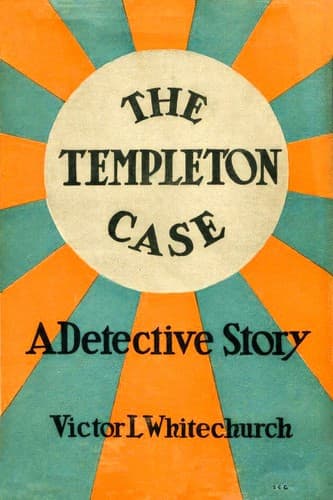
The Templeton caseWhitechurch, Victor L. (Victor Lorenzo)
General
The Templeton case
Whitechurch, Victor L. (Victor Lorenzo)
Detective and mystery stories; Murder -- Investigation -- Fiction; Police -- England -- Fiction
“Why, of course I do! Ever since I can remember. He was a great friend
of my mother, and always so kind to me. I always called him Uncle.
Why, I only had a letter from him last week. He was coming to London,
soon, he said.”
“Oh, you poor dear! Are you _sure_ it’s the same man, Winnie?”
“It must be,” said the girl, looking at the paper again. “Yes—when he
wrote he said he was yachting on the South Coast. Oh, Maude, what am I
to do?”
Maude had risen from the seat and was looking over her friend’s
shoulder.
“Look,” she said, pointing with her finger, “he’d been dining the
night before with his cousin, Canon Fittleworth. Do you know him?”
“I’ve heard Uncle speak of him. No, I’ve never met him.”
“Why not write to him—or telegraph?”
Winnie shook her head.
“I don’t know,” she replied. “Of course, you see, Mr. Templeton isn’t
any relation of mine. But I was awfully fond of him. Poor old Uncle! I
know what I _will_ do, dear,” she went on impulsively.
“What?”
“I _must_ finish that cover this morning. But I’ll go down to
Frattenbury this afternoon and see Canon Fittleworth—yes, I will.”
Maude had glanced at her watch again, and was putting on her gloves.
“Will it be any good?” she asked.
“Oh, Maude, I _must_! He’s been so awfully good to me. Why, my dear,
when my mother died, and there wasn’t a penny, it was Mr. Templeton
who paid for my art training. I owe my living to him—really. Don’t you
see?”
Maude nodded her head sympathetically.
“I know, dear. I should do just the same. I’m _so_ sorry. Yes—go down
to Frattenbury. I wish I could go with you, but I simply _have_ to get
to the office.”
“Don’t worry about me, dear. I shall take a handbag in case I stay the
night—I can get a room at an hotel. I’ll wire and let you know if I’m
not coming back this evening.”
“Thanks. I’d like to know. Good-bye!”
And she nodded brightly as she left the room to go to her work. She
was sub-editress of one of the many popular weeklies issued by a
well-known firm of publishers and newspaper proprietors. The two
“bachelor” girl friends had been sharing the same flat for nearly a
year.
Winnie Cotterill slowly finished her breakfast, reading the details of
the tragedy as she did so—a couple of columns in the usual blaring
journalistic style, followed by a short article on local police
methods, detrimental, of course, to the said local police. She was
getting into a calmer frame of mind now, though still much upset by
the shock of hearing such unexpected news.
Breakfast over, she went into the little adjacent room she dignified
by the name of “studio” and got to work on the magazine cover. When it
was finished, she took a bus to Fleet Street and deposited it with her
editor, in whose office she consulted a Bradshaw.
She had already packed a small handbag and, after a light lunch at a
restaurant, she caught the afternoon train to Frattenbury, arriving
about six, and at once made her way to the Close.
Public-domain text, read in full here on John Shaqi.
Reviews
Reviews
No reviews yet
Be the first to share your thoughts on this work.
Join the Discussion
Join the discussion
Sign in to leave a comment or review.
Sign InorCreate an account