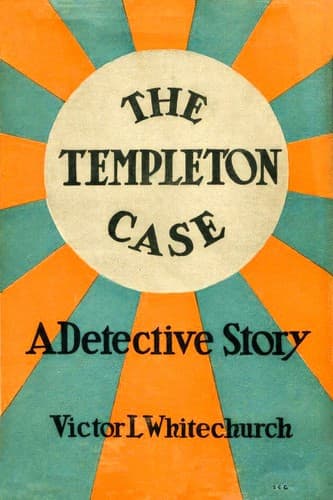
The Templeton caseWhitechurch, Victor L. (Victor Lorenzo)
General
The Templeton case
Whitechurch, Victor L. (Victor Lorenzo)
Detective and mystery stories; Murder -- Investigation -- Fiction; Police -- England -- Fiction
“Don’t worry, dear,” she said. “The Canon has said the police don’t
necessarily suspect him. If he is really the Mr. Grayson you know—and
he may not be, after all—of course he will be able to explain. You’re
quite done up with all this terrible affair, and I’m going to take you
to bed. Come along.”
“Thank you,” said Winnie gratefully, “you are kind to me. I’m very
silly, I know, but I can’t bear to think that he—he is suspected. I
know he couldn’t have done it.”
“Of course he couldn’t,” said Mrs. Fittleworth soothingly. “Now—I must
insist. You come to bed, dear.”
When the Canon himself went to bed that night he had to listen to a
little lecture. And he took it calmly—from force of habit—much more
calmly than if it had come from the Dean, or even the Bishop. Whereat
it is evident that even for cathedral dignitaries there is a higher
court than the mere ecclesiastical.
“Really, Charles,” said his wife, “you ought to have noticed that the
poor girl had gone through quite enough for one day.”
The Canon tried defensive argument, which was foolish of him—for he
ought to have remembered that he never succeeded.
“But how was I to know, my dear, that she was acquainted with the
young man?”
“Oh, do be reasonable, Charles. You ought not to have mentioned the
subject of the murder at all at that time of night. Doris and I had
been doing our best to get the girl’s mind off it. And then you came
in and started it all again!”
“Why didn’t you stop me, my dear?”
“Stop you!” exclaimed his wife; “stop you when you once begin to hold
forth on a subject. How can anyone stop you? _I_ can’t. There. I know
you didn’t mean to upset her, but you ought to have thought.”
“I suppose I ought,” said the Canon resignedly. “I’m very sorry. Good
night, my dear.”
CHAPTER IX
The Cigar Band
The crowd that had assembled at the inquest at Marsh Quay loitered for
a while discussing the one important topic. Newspaper men were busy
with notebook and camera. The removal of the body of Reginald
Templeton from the “Mariner’s Arms” to the mortuary at Frattenbury,
pending the funeral the next day, was eagerly watched. Members of the
jury, for the most part stolid agricultural labourers or boatmen, were
closely questioned by friends or relatives, but, on the whole,
recognising the importance of their office, were not communicative.
Mr. Proctor refused to say a word to anyone. He came out of the
“Mariner’s Arms,” lighting a cigar as he did so, and walked straight
over to his house opposite, blandly smiling at an irrepressible
reporter who asked him to pose for his camera.
The coroner drove away with the Chief Constable in the latter’s car,
austere and grave as usual. Anthony Crosby, the superintendent and
Colson held a brief consultation in the inn parlour, where it was
arranged that the lawyer should call at the police station the next
morning for further discussion.
Public-domain text, read in full here on John Shaqi.
Reviews
Reviews
No reviews yet
Be the first to share your thoughts on this work.
Join the Discussion
Join the discussion
Sign in to leave a comment or review.
Sign InorCreate an account