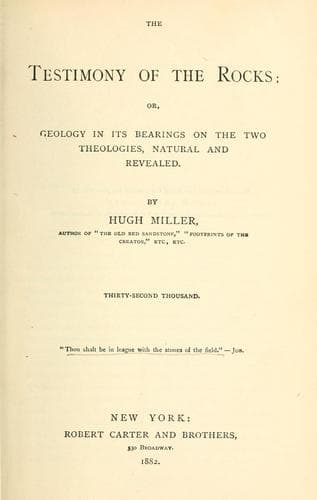
The Testimony of the Rocks: or, Geology in Its Bearings on the Two Theologies, Natural and RevealedMiller, Hugh
Philosophy
The Testimony of the Rocks: or, Geology in Its Bearings on the Two Theologies, Natural and Revealed
Miller, Hugh
Bible and geology; Creation; Religion and science
There could not be a simpler incident. And yet, rightly apprehended, it
reads its lesson. You have all visited the scene of it, and must all
have been struck by the three salient points, if I may so speak, by
which that noble gallery lays strongest hold of the memory, and most
powerfully impresses the imagination,--by its gigantic plants of the
first period (imperfectly as these are represented in the collection),
by its strange misproportioned sea monsters and creeping things of the
second, and by its huge mammals of the third. Amid many thousand various
objects, and a perplexing multiplicity of detail, which it would
require the patient study of years even partially to classify and know,
these are the great prominent features of the gallery, that
involuntarily, on the part of the visitor, force themselves on his
attention. They at once pressed themselves on the attention of the
intelligent though unscientific mechanics, and, I doubt not, still dwell
vividly in their recollections; and I now ask you, when you again visit
the national museum, and verify the fact of the great prominence of
these classes of objects, to bear in mind, that the gallery in which
they occur represents, both in the order and character of its contents,
the course of creation. I ask you to remember that, had there been human
eyes on earth during the Palæozoic, Secondary, and Tertiary periods,
they would have been filled in succession by the great plants, the great
reptiles, and the great mammals, just as those of the mechanics were
filled by them in the museum. As the sun and moon, when they first
became visible in the heavens, would have seemed to human eyes--had
there been human eyes to see--not only the greatest of the celestial
lights, but peculiarly the prominent objects of the epoch in which they
appeared, so would these plants, reptiles, and mammals, have seemed in
succession the prominent objects of the several epochs in which _they_
appeared. And, asking the geologist to say whether my replies to the
mechanics were not, with all their simplicity, true to geological fact,
and the theologian to say whether the statements which they embodied
were not, with all their geology, true to the scriptural narrative, I
ask further, whether (of course, making due allowance for the laxity of
the terms botanic and zoological of a primitive language unadapted to
the niceties of botanic or zoologic science) the Mosaic account of
creation could be rendered more essentially true, than we actually find
it, to the history of creation geologically ascertained. If, taking the
Mosaic days as equivalent to lengthened periods, we hold that, in giving
their brief history, the inspired writer seized on but those salient
points that, like the two great lights of the day and night, would have
arrested most powerfully, during these periods, a human eye, we shall
find the harmony of the two records complete. In your visit to the
Public-domain text, read in full here on John Shaqi.
Reviews
Reviews
No reviews yet
Be the first to share your thoughts on this work.
Elsewhere in the archive
Join the Discussion
Join the discussion
Sign in to leave a comment or review.
Sign InorCreate an account