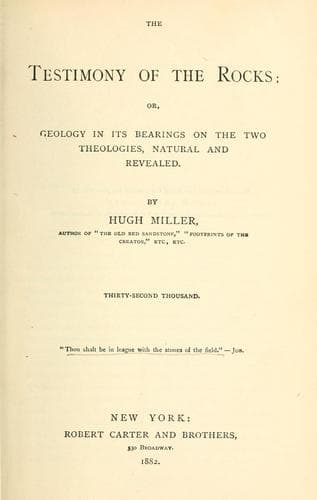
The Testimony of the Rocks: or, Geology in Its Bearings on the Two Theologies, Natural and RevealedMiller, Hugh
Philosophy
The Testimony of the Rocks: or, Geology in Its Bearings on the Two Theologies, Natural and Revealed
Miller, Hugh
Bible and geology; Creation; Religion and science
museum, I would yet further ask you to mark the place of the human
skeleton in the great gallery. It stands--at least it stood only a few
years ago--in the same apartment with the huge mammifers. And it is
surely worthy of remark, that while in both the sacred and geologic
records a strongly defined line separates between the period of plants
and the succeeding periods of reptiles, and again between the period of
reptiles and the succeeding period of mammals, no line in either record
separates between this period of mammals and the human period. Man came
into being as the lastborn of creation, just ere the close of that sixth
day--the third and terminal period of organic creation--to which the
great mammals belong. Let me yet further remark, that in each of these
three great periods we find, with respect to the classes of existences,
vegetable or animal, by which they were most prominently characterized,
certain well marked culminating points together, if I may so express
myself,--twilight periods of morning dawn and evening decline. The
plants of the earlier and terminal systems of the Palæozoic division are
few and small: it was only during the protracted _eons_ of the
Carboniferous period that they received their amazing development,
unequalled in any previous or succeeding time.[16] In like manner, in
the earlier or Triassic deposits of the Secondary division, the
reptilian remains are comparatively inconsiderable; and they are almost
equally so in its Cretaceous or later deposits. It was during those
middle ages of the division, represented by its Liassic, Oolitic, and
Wealden formations, that the class existed in that abundance which
rendered it so peculiarly, above every other age, an age of creeping
things and great sea monsters. And so also, in the Tertiary, regarded
as but an early portion of the human division, there was a period of
increase and diminution,--a morning and evening of mammalian life. The
mammals of its early Eocene ages were comparatively small in bulk and
low in standing; in its concluding ages, too, immediately ere the
appearance of man, or just as he had appeared, they exhibited, both in
size and number, a reduced and less imposing aspect. It was chiefly in
its middle and latter, or Miocene, Pliocene, and Pleistocene ages, that
the myriads of its huger giants,--its dinotheria, mastodons, and
mammoths,--cumbered the soil. I, of course, restrict my remarks to the
three periods of organic life, and have not inquired whether aught
analogous to these mornings and evenings of increase and diminution need
be sought after in any of the others.
Public-domain text, read in full here on John Shaqi.
Reviews
Reviews
No reviews yet
Be the first to share your thoughts on this work.
Elsewhere in the archive
Join the Discussion
Join the discussion
Sign in to leave a comment or review.
Sign InorCreate an account