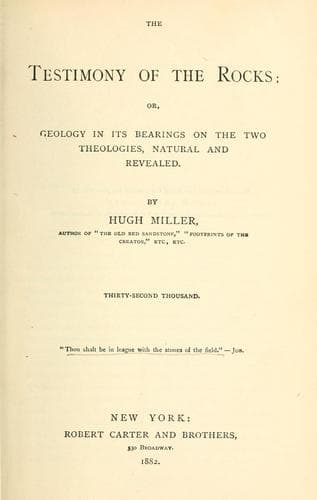
The Testimony of the Rocks: or, Geology in Its Bearings on the Two Theologies, Natural and RevealedMiller, Hugh
Philosophy
The Testimony of the Rocks: or, Geology in Its Bearings on the Two Theologies, Natural and Revealed
Miller, Hugh
Bible and geology; Creation; Religion and science
One other remark ere I conclude. In the history of the earth which we
inhabit, molluscs, fishes, reptiles, mammals, had each in succession
their periods of vast duration; and then the human period began,--the
period of a fellow worker with God, created in God's own image. What is
to be the next advance? Is there to be merely a repetition of the
past?--an introduction a second time of man made in the image of God?
No. The geologist, in those tables of stone which form his records,
finds no example of dynasties once passed away again returning. There
has been no repetition of the dynasty of the fish, of the reptile, of
the mammal. The dynasty of the future is to have glorified man for its
inhabitant; but it is to be the dynasty--"the _kingdom_"--not of
glorified man made in the image of God, but of God himself in the form
of man. In the doctrine of the two conjoined natures, human and Divine,
and in the further doctrine that the terminal dynasty is to be
peculiarly the dynasty of HIM in whom the natures are united, we find
that required progression beyond which progress cannot go. We find the
point of elevation never to be exceeded meetly coincident with the final
period never to be terminated,--the infinite in height harmoniously
associated with the eternal in duration. Creation and the Creator meet
at one point, and in one person. The long ascending line from dead
matter to man has been a progress Godwards,--not an asymptotical
progress, but destined from the beginning to furnish a point of union;
and occupying that point as true God and true man,--as Creator and
created,--we recognize the adorable Monarch of all the future!
LECTURE FOURTH.
THE MOSAIC VISION OF CREATION.
The history of creation is introduced into the "Paradise Lost" as a
piece of narrative, and forms one of the two great episodes of the poem.
Milton represents the common father of the race as "led on" by a desire
to know
"What within Eden or without was done
Before his memory;"
Public-domain text, read in full here on John Shaqi.
Reviews
Reviews
No reviews yet
Be the first to share your thoughts on this work.
Elsewhere in the archive
Join the Discussion
Join the discussion
Sign in to leave a comment or review.
Sign InorCreate an account