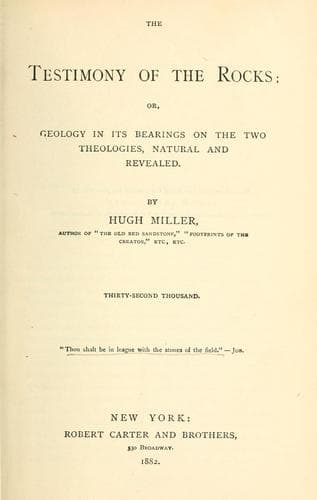
The Testimony of the Rocks: or, Geology in Its Bearings on the Two Theologies, Natural and RevealedMiller, Hugh
Philosophy
The Testimony of the Rocks: or, Geology in Its Bearings on the Two Theologies, Natural and Revealed
Miller, Hugh
Bible and geology; Creation; Religion and science
and straightway Raphael, "the affable archangel," in compliance with the
wish, enters into a description of the six days' work of the Divine
Creator,--a description in which, as Addison well remarks, "the whole
energy of our tongue is employed, and the several great scenes of
creation rise up to view, one after another, in such a manner, that the
reader seems present at this wonderful work, and to assist among the
choirs of angels who are spectators of it." In the other great episode
of the poem,--that in which the more prominent changes which were to
happen in after time upon the earth are made to pass before Adam, he is
represented as carried by Michael to the top of a great mountain, lofty
as that on which in a long posterior age the Tempter placed our Saviour,
and where the coming events are described as rising up in vision before
him. In the earlier episode, as in those of the Odyssey and Æneid, in
which heroes relate in the courts of princes the story of their
adventures, there is but narrative and description; in the later, a
series of magnificent pictures, that form and then dissolve before the
spectator, and comprise, in their vivid tints and pregnant outlines, the
future history of a world. And one of these two episodes,--that which
relates to the creation of all things,--must have as certainly had a
place in human history as in the master epic of England. Man would have
forever remained ignorant of many of those events related in the opening
chapters of Scripture, which took place ere there was a human eye to
witness, or a human memory to record, had he not been permitted, like
Adam of old, to hold intercourse with the intelligences that had
preceded him in creation, or with the great Creator himself, the Author
of them all; and the question has been asked of late, both in our own
country and on the Continent, What was the form and nature of the
revelation by which the pre-Adamic history of the earth and heavens was
originally conveyed to man? Was it conveyed, like the sublime story of
Raphael, as a piece of narrative, dictated, mayhap, to the inspired
penman, or miraculously borne in upon his mind? Or was it conveyed by a
succession of sublime visions like that which Michael is represented as
calling up before Adam, when, purging his "visual nerves with euphrasy
and rue," he enabled him to see, in a series of scenes, the history of
his offspring from the crime of Cain down to the destruction of the Old
World by a flood? The passages in which the history of creation is
recorded give no intimation whatever of their own history; and so we are
left to balance the probabilities regarding the mode and form in which
they were originally revealed, and to found our ultimate conclusions
respecting them on evidence, not direct, but circumstantial.
Public-domain text, read in full here on John Shaqi.
Reviews
Reviews
No reviews yet
Be the first to share your thoughts on this work.
Elsewhere in the archive
Join the Discussion
Join the discussion
Sign in to leave a comment or review.
Sign InorCreate an account