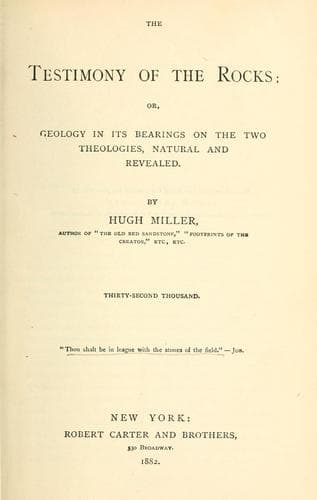
The Testimony of the Rocks: or, Geology in Its Bearings on the Two Theologies, Natural and RevealedMiller, Hugh
Philosophy
The Testimony of the Rocks: or, Geology in Its Bearings on the Two Theologies, Natural and Revealed
Miller, Hugh
Bible and geology; Creation; Religion and science
picture than a creative history, and from Ammon to the effect that the
author of it evidently takes the position of a beholder of creation, the
learned German concludes his general statement by remarking, that the
scenes of the chapter are prophetic tableaux, each containing a leading
phase of the drama of creation. "Before the eye of the seer," he says,
"scene after scene is unfolded, until at length, in the seven of them,
the course of creation, in its main _momenta_, has been fully
represented." The revelation has every characteristic of prophecy by
vision,--prophecy by eye-witnessing; and may be perhaps best understood
by regarding it simply as an exhibition of the actual phenomena of
creation presented to the mental eye of the prophet under the ordinary
laws of perspective, and truthfully described by him in the simple
language of his time.
In our own country a similar view has been taken by the author of a
singularly ingenious little work which issued about two years ago from
the press of Mr. Constable of Edinburgh, "The Mosaic Record in Harmony
with Geology."[17] The writer, however, exhibits, in dealing with his
subject, the characteristic sobriety of the Anglo-Saxon mind; and while
the leading features of his theory agree essentially with those of the
Continental one, he does not press it so far. In canvassing the _form_
of the revelation made to Moses in the opening of Genesis, he discusses
the nature of the inspiration enjoyed by that great prophet; and thus
retranslates literally from the Hebrew the passage in which the Divine
Being is himself introduced as speaking direct on the point in the
controversy raised by Aaron and Miriam. "And He [the Lord] said, hear
now my words: If he [Moses] were _your_ prophet [subordinate, or at
least not superior, to the prophetess and the high priest], I, Jehovah,
in the vision to him would make myself known: in the dream would I speak
to him. Not so _my_ servant Moses [God's prophet, not theirs]; in all my
house faithful is he. Mouth to mouth do I speak to him, and vision, but
not in dark speeches; and likeness of Jehovah he beholds." Moses, then,
was favored with "visions without dark speeches."
Public-domain text, read in full here on John Shaqi.
Reviews
Reviews
No reviews yet
Be the first to share your thoughts on this work.
Elsewhere in the archive
Join the Discussion
Join the discussion
Sign in to leave a comment or review.
Sign InorCreate an account